|
WORLD
ECOTOURISM SUMMIT
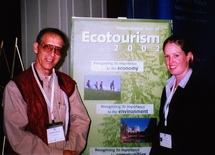 A number of ECOCLUB Members
attended the
World Ecotourism Summit at Quebec. A number of ECOCLUB Members
attended the
World Ecotourism Summit at Quebec.
Two of them, Ecolodge Member
Mr. Fransisco Sandoval of Uxlabil,
Guatemala and Expert Member Ms
Rachel Dodds, met and sent us the picture on the left. ECOCLUB also
interviewed Ms Dodds to find out what transpired at the World Ecotourism Summit
- click here for the first-hand report.
ECOLODGE
MEMBERSHIP:
In May Mocking
Bird Hill, of Jamaica renewed their membership and support of ECOCLUB,
and Hibiscus Valley Inn
of Dominica became a new member.
NEW
EXPERT MEMBERS:
We also welcomed the following Experts to our Expert Member team in
May:
Mr. Romas Mecionis,
Head Ecologist at Nemunas Delta National Park, Silute, Lithuania
Mr. Himanshu Rauth,
Senior Executive, Sebayan Sangha Organisation, Jharkand, India
Dr. Fransesca Visintin,
Researcher at the University of Udine, Italy
Lcda. Natalia Rivera,
General Coordinator, Monte Caimito Integral Reserve, Ecuador
Mr. Thanes Peeranond,
Tour Operator, Phuket, Thailand
Mr. Andre Dukhia,
Community Development Officer at the Office of Empowerment, Guyana.
International Workshop on Carrying Capacity in Protected Areas,
Athens, Greece, organised by WWF Greece.
 A
conference attended by top-ranking academics and consultants took place in
Athens on Friday 31 of May and Saturday 1 June, organised by WWF Greece. Among
the distinguished participants were Ms Pam Wight, Rapporteur to the World
Ecotourism Summit, Professor Richard Butler of Surrey University, Professor
Stephen Mc Cool, U. of Montana, Professor Trevor Sofield, U. of
Tasmania and Prof. Robert Manning, U. of Vermont. Various measures
of carrying capacity and related indices were debated at the academic and
empirical level, and although there were differing views on the applicability
and measurability of carrying capacity and of competing measurement systems like
visitor impact management, the need to monitor the effect of tourism on
protected areas was something most participants agreed on. The conference was
opened by the vice Minister for Development, Mr. Georgakopoulos, who
promised that he will anxiously wait for the proceedings and take into
consideration the deliberations of the distinguished panelists. Mr.
Georgakopoulos, referred interchangeably to ecotourism and agrotourism and
stated that "we should neither exaggerate when we want to conserve nor when
we want to develop". Still the minister believed that "Greek nature in
the interior should not have the same luck as that of the Greek coast",
probably referring to mass tourism. A statement from the vice Minister for the
Environment was read, maintaining that "the real target of tourist policy
should not be the "extension of the tourist season" an old cliché of
officials associated with greek tourism, "but sustainable
development". The representative of the Ministry of Agriculture Mr.
Efstathiadis, Head of the Forestry Department, pointed out that when man
deserts the forests, then forests desert man and that we should not talk of
protected areas as if they were empty spaces. A representative from the private
sector, Mr. Tsoukalas, director of a local major adventure tour operator,
complained that laws and regulations are never in sync with development, they
either predate development and are outdated, or they are absent and follow when
things are too late. A brief account of some of the presentations is as follows:
Professor Trevor Sofield analysed the little known effect that China has
the largest mass tourism industry with 640 million domestic tourists per annum,
and showed some interesting slides depicting the massive infrastructure program
that chinese authorities have undertaken within protected areas to be able to
manage millions of visitors visiting on public holidays, including cement
pathways going up mountains for kilometres. Professor Sofield, an expert on
Chinese Protected Areas, maintained that the Chinese government has an
anthropocentric philosophy in P.A. management, and that PAs there exist
primarily for recreation purposes, in contrast to the western paradigm.
Commodification however was evident there as well, even next to holy mountaintop
shrines. Professor Stephen Mc Cool argued that there is not a direct
relationship between tourist use level and impact but that impact rises very
fast for the first few visitors and then increases at a lower rate. Dr. Ted
Manning, a WTO Expert, argued that pricing is not an effective way to limit
stress from visitation, and that a protected area should not be named as such
before a planning and control system is in place. Professor Coccossis
from the U. of Thessalia, argued that no social justice can exist if pricing
measures are used for P.A. access. Ms. Pam Wight presented more recent
alternatives to carrying capacity and argued in favour of the use of public
transport in P.As. Ms Wight also presented modern approaches to Visitor
Management such as interactive computer displays at Park entrances. In an
intervention Dr. Fotiou
of the Greek Wetland Protection Centre, pointed out that in the case of Greece
introducing public transport to P.A.s would fail as people would simply continue
using their automobile to visit a Protected Area prefering to experience nature
as independently as possible. Mr. Zoltan Kun from Pan Parks, a network
advocating the certification of P.A.s in Europe explained their approach and
monitoring procedures, and maintained that most European Union parks are under
threat due to inadequate management, conflicts with local people and lack of
trained personnel. He made particular reference to what seemed a very empty
management building in Dadia Forest Reserve in Greece, a candidate park for the
Pan Parks network, and wondered why were bothering to hold a workshop on
managing visitors when management buildings stay empty - no reply was offered. Dr.
Andrew Holden of Luton University pointed out how important little details
can be: for example the members of a tourist group visiting a Nepalese national
park ordering the same meal so that there is economy in the wood used as cooking
fuel or a visitor making or not making gifts to local children. Professor
Butler argued that carrying capacity has 40 years of work behind it and thus
it should not be lightly dismissed in favour of untested indices. "Numbers
still count", he argued. He was also in favour of "total
protection" in some instances and of regulation by competent authorities. Mr.
Alexis Hadzidakis, Architect-Planner with the Greek National Tourism
Organisation (GNTO) caused a sensation, by admitting that the constant change of
leadership at his organisation resulted in hundreds of interesting studies to
remain just that, studies, and by presenting a caricature of the way wide
consultations are always made with all interest groups involved and then someone
always decides to better leave things as they are so as not to annoy anyone.
Apparently the policy of the Greek Tourism Organisation in the last two decades,
focused on the policy of "Saturated Areas", approaching the issue of
management of Protected Areas from the opposite end (how much development can
fit before an area is saturated). But we were told that the "Saturated
Areas" approach is now seen as dated by GNTO and that the current tendency
is favouring the creation of management bodies for each protected area, after
... wide consultations with interested parties. On behalf of active NGOs, Mr.
Panayiotis Dendrinos made a very interesting presentation on the day to day
monitoring and patrolling techniques of his MOm / Hellenic Society for the
Protection of the Monk Seal, in the National Marine Park of Alonissos, in
Greece. Effective monitoring and fines, and the cooperation of most local
fishermen have greatly reduced illegal activities in the Alonissos National Park
and the seal population has largely recovered. From the floor, a high ranking
official of the Ministry of the Environment, suddenly engaged in an unprovoked
public self-criticism, pondering on whether the policies of the Ministry in
relation to conservation had been at all successful over the last 20 years, to
the bewilderment of the audience. Ms. Dora Skartsi, responsible for the
WWF program at Dadia Forest Reserve presented disappointing data on the quality
of domestic visitors to the reserve; it appears that only 4.3% of visitors
decided to walk the trails, and only 40% bother to take the mini-bus to see the
attraction, that is the feeding area of raptors, the rest of the visitors prefer
to stay at the restaurant / information complex. Finally Dr. P Tsartas
from the U. of Aegean supported carrying capacity as a valid tool since it helps
combine the findings of scientists from many disciplines. At the end of the
conference there were remarks from the audience including one from an
agronomist, who aggressively claimed that nothing had been said, and that
"we were back where we started" and a more sensible remark by a
student, who said that local people do not have a clue what carrying capacity
is, they see the local environment as an indispensable part of their
housekeeping. A
conference attended by top-ranking academics and consultants took place in
Athens on Friday 31 of May and Saturday 1 June, organised by WWF Greece. Among
the distinguished participants were Ms Pam Wight, Rapporteur to the World
Ecotourism Summit, Professor Richard Butler of Surrey University, Professor
Stephen Mc Cool, U. of Montana, Professor Trevor Sofield, U. of
Tasmania and Prof. Robert Manning, U. of Vermont. Various measures
of carrying capacity and related indices were debated at the academic and
empirical level, and although there were differing views on the applicability
and measurability of carrying capacity and of competing measurement systems like
visitor impact management, the need to monitor the effect of tourism on
protected areas was something most participants agreed on. The conference was
opened by the vice Minister for Development, Mr. Georgakopoulos, who
promised that he will anxiously wait for the proceedings and take into
consideration the deliberations of the distinguished panelists. Mr.
Georgakopoulos, referred interchangeably to ecotourism and agrotourism and
stated that "we should neither exaggerate when we want to conserve nor when
we want to develop". Still the minister believed that "Greek nature in
the interior should not have the same luck as that of the Greek coast",
probably referring to mass tourism. A statement from the vice Minister for the
Environment was read, maintaining that "the real target of tourist policy
should not be the "extension of the tourist season" an old cliché of
officials associated with greek tourism, "but sustainable
development". The representative of the Ministry of Agriculture Mr.
Efstathiadis, Head of the Forestry Department, pointed out that when man
deserts the forests, then forests desert man and that we should not talk of
protected areas as if they were empty spaces. A representative from the private
sector, Mr. Tsoukalas, director of a local major adventure tour operator,
complained that laws and regulations are never in sync with development, they
either predate development and are outdated, or they are absent and follow when
things are too late. A brief account of some of the presentations is as follows:
Professor Trevor Sofield analysed the little known effect that China has
the largest mass tourism industry with 640 million domestic tourists per annum,
and showed some interesting slides depicting the massive infrastructure program
that chinese authorities have undertaken within protected areas to be able to
manage millions of visitors visiting on public holidays, including cement
pathways going up mountains for kilometres. Professor Sofield, an expert on
Chinese Protected Areas, maintained that the Chinese government has an
anthropocentric philosophy in P.A. management, and that PAs there exist
primarily for recreation purposes, in contrast to the western paradigm.
Commodification however was evident there as well, even next to holy mountaintop
shrines. Professor Stephen Mc Cool argued that there is not a direct
relationship between tourist use level and impact but that impact rises very
fast for the first few visitors and then increases at a lower rate. Dr. Ted
Manning, a WTO Expert, argued that pricing is not an effective way to limit
stress from visitation, and that a protected area should not be named as such
before a planning and control system is in place. Professor Coccossis
from the U. of Thessalia, argued that no social justice can exist if pricing
measures are used for P.A. access. Ms. Pam Wight presented more recent
alternatives to carrying capacity and argued in favour of the use of public
transport in P.As. Ms Wight also presented modern approaches to Visitor
Management such as interactive computer displays at Park entrances. In an
intervention Dr. Fotiou
of the Greek Wetland Protection Centre, pointed out that in the case of Greece
introducing public transport to P.A.s would fail as people would simply continue
using their automobile to visit a Protected Area prefering to experience nature
as independently as possible. Mr. Zoltan Kun from Pan Parks, a network
advocating the certification of P.A.s in Europe explained their approach and
monitoring procedures, and maintained that most European Union parks are under
threat due to inadequate management, conflicts with local people and lack of
trained personnel. He made particular reference to what seemed a very empty
management building in Dadia Forest Reserve in Greece, a candidate park for the
Pan Parks network, and wondered why were bothering to hold a workshop on
managing visitors when management buildings stay empty - no reply was offered. Dr.
Andrew Holden of Luton University pointed out how important little details
can be: for example the members of a tourist group visiting a Nepalese national
park ordering the same meal so that there is economy in the wood used as cooking
fuel or a visitor making or not making gifts to local children. Professor
Butler argued that carrying capacity has 40 years of work behind it and thus
it should not be lightly dismissed in favour of untested indices. "Numbers
still count", he argued. He was also in favour of "total
protection" in some instances and of regulation by competent authorities. Mr.
Alexis Hadzidakis, Architect-Planner with the Greek National Tourism
Organisation (GNTO) caused a sensation, by admitting that the constant change of
leadership at his organisation resulted in hundreds of interesting studies to
remain just that, studies, and by presenting a caricature of the way wide
consultations are always made with all interest groups involved and then someone
always decides to better leave things as they are so as not to annoy anyone.
Apparently the policy of the Greek Tourism Organisation in the last two decades,
focused on the policy of "Saturated Areas", approaching the issue of
management of Protected Areas from the opposite end (how much development can
fit before an area is saturated). But we were told that the "Saturated
Areas" approach is now seen as dated by GNTO and that the current tendency
is favouring the creation of management bodies for each protected area, after
... wide consultations with interested parties. On behalf of active NGOs, Mr.
Panayiotis Dendrinos made a very interesting presentation on the day to day
monitoring and patrolling techniques of his MOm / Hellenic Society for the
Protection of the Monk Seal, in the National Marine Park of Alonissos, in
Greece. Effective monitoring and fines, and the cooperation of most local
fishermen have greatly reduced illegal activities in the Alonissos National Park
and the seal population has largely recovered. From the floor, a high ranking
official of the Ministry of the Environment, suddenly engaged in an unprovoked
public self-criticism, pondering on whether the policies of the Ministry in
relation to conservation had been at all successful over the last 20 years, to
the bewilderment of the audience. Ms. Dora Skartsi, responsible for the
WWF program at Dadia Forest Reserve presented disappointing data on the quality
of domestic visitors to the reserve; it appears that only 4.3% of visitors
decided to walk the trails, and only 40% bother to take the mini-bus to see the
attraction, that is the feeding area of raptors, the rest of the visitors prefer
to stay at the restaurant / information complex. Finally Dr. P Tsartas
from the U. of Aegean supported carrying capacity as a valid tool since it helps
combine the findings of scientists from many disciplines. At the end of the
conference there were remarks from the audience including one from an
agronomist, who aggressively claimed that nothing had been said, and that
"we were back where we started" and a more sensible remark by a
student, who said that local people do not have a clue what carrying capacity
is, they see the local environment as an indispensable part of their
housekeeping.
ECOCLUB made three
interventions at the conference that included the following points: 1. A problem
with using carrying capacity as a tool is how to manage and measure those
visitors (and their effects) that do not want to be measured or managed: In
Greece, a large part of visitors to protected areas are illegal recreational
hunters, and fishermen. 2. The workshop was deliberating without the presence of
important Protected Area players such as hoteliers, tour operators, communities,
and municipal authorities 3. Most protected areas around the world are to be
found in border areas, or internal "border" areas (i.e. high
mountains) in countries with social problems or even civil strife and this makes
the presence and especially the management by international NGOs in some cases
politically contentious, meaning PA managers (or tourism) can not operate in a
vacuum, ignoring political parameters. 3. The Internet, as a tool of carrying
capacity, had not been mentioned at all, (neither was it mentioned in the Quebec
declaration by the way) though it potentially has an infinite carrying capacity
to inform, to assist protected area managers in their contact and management of
visitors, to transmit live pictures through webcams for recreation, monitoring
and research, to prepare visitors through accurate and up to date information,
to sell local products made in or near the protected area thus raising revenue
for conservation, to demarket, to show parts of the protected areas that are
off-limits to visitors, to create custom made itineraries through on-line forms
based on visitor preferences and so on. We also pointed out how expensive, and
environmentally challenged, it would be to bring again (fly in) together all the
participants in a conference room, compared to communicating through the
Internet which is a sort of permanent conference, or in the old fashioned
expression a sort of "permanent revolution".
Above all however, it was a
high-powered meeting and a rare and much needed event in Greece, which lags
behind in terms of effective P.A. management, and congratulations are due to the
organisers WWF Greece both for the idea and the implementation. Following the
event, the Greek Minister of Environment, Planning and Public Works announced
the creation of management bodies for 24 wetlands and the creation of a special
fund for protected areas.
European
Union Hotel Ecolabeling Scheme
The on-going discussion on
developing a European
Ecolabeling scheme, in which ECOCLUB was invited to take part as mentioned in the April ECOCLUB
News is progressing. The minutes of the 2nd Ad-Hoc Working Group meeting on 14
March 2002 in Athens, Greece can be found at http://europa.eu.int/comm/environment/ecolabel/pdf/tourism/2ahwgminutes_140302.pdf
The minutes recorded ECOCLUB's view that social issues such as benefits to the local
community
through employment and the sourcing of local products should also be included in the
european hotel eco-label criteria, as well as the fact that certification should
be priced so as to be accessible by small hotels.
More details on the progress of the scheme can be found at:
http://europa.eu.int/comm/environment/ecolabel/producers/pg_tourism.htm
Copyright © 1999-2002 ECOCLUB
S.A. All Rights Reserved.
| News Contents | ECOCLUB
entrance | Ecolodges
| Experts | Ecoproducts
|
|