|

back to Member Benefits Index
|
20% Discount on Book or CD:
Offer Ref: B01/0611 |
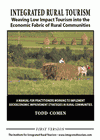 Integrated
Rural Tourism: Weaving Low Impact Tourism into the Economic Fabric
of Rural Communities. Integrated
Rural Tourism: Weaving Low Impact Tourism into the Economic Fabric
of Rural Communities.
Author: Professor Todd Comen.
Publisher: The Institute for Integrated Rural Tourism, Middlesex VT,
USA.
2006. Pp. 169. Available as Book or
CD.
To obtain the 20% Discount simply include your ECOCLUB Member ID when ordering.
Contact us if you do not remember your
Member ID
 Excerpt
Order |
 REVIEW
The author is the Director
of the Institute for Integrated Rural Tourism and an Associate Professor
of Business and Hospitality Management at Johnson State College in
Vermont and a Member of ECOCLUB. Beyond his academic expertise, he first
obtained practical knowledge of rural tourism in 1982, as a developer
and operator of a small country inn on a farm in northern California,
and as a consultant in numerous rural tourism projects around the world
ever since. Professor Comen has developed a new strategy for rural
economic development and poverty alleviation, called Integrated Rural
Tourism (IRT).
REVIEW
The author is the Director
of the Institute for Integrated Rural Tourism and an Associate Professor
of Business and Hospitality Management at Johnson State College in
Vermont and a Member of ECOCLUB. Beyond his academic expertise, he first
obtained practical knowledge of rural tourism in 1982, as a developer
and operator of a small country inn on a farm in northern California,
and as a consultant in numerous rural tourism projects around the world
ever since. Professor Comen has developed a new strategy for rural
economic development and poverty alleviation, called Integrated Rural
Tourism (IRT).
As defined by the author,
IRT, is perfectly compatible with the way this newspaper defines
Ecotourism, within the context of rural communities. The author’s
intention was to create a manual for practitioners working to effect
socioeconomic improvement in rural communities through tourism
development and this intention has been achieved, particularly for
community trainers and development workers, while the book will also
appeal to eco & socially-minded SMEs.
This manual provides a
practical, digestible, memorable and transferable account of activities
and useful tips that have been tested & proven in rural areas around the
world. Other books may be richer on statistics, academic theory and
minutiae but in the end they really offer an assortment of usually
incomparable case studies, rather than a practical guide, like Professor
Comen’s book.
As the author acknowledges,
IRT is “not an easy approach to economic development, nor is it a
panacea for economic prosperity” (indeed there are no panaceas)
and is “much more difficult than concentrating on heritage sites or
natural areas”, as it needs a number of prerequisites – not least, a
community eager to develop tourism in a communal, eco-friendly way, and
a well-meaning, selfless outsider with a strong stomach!
Indeed, among the most
interesting sections of the book, is the one dealing with the initial
introduction of the concept of IRT by an IRT proponent/practitioner to a
community, as a good beginning is a half of the battle. I particularly
enjoyed the refreshing section dealing with Menu development, Food
Safety and Sanitation, and in such a detailed manner, and the somewhat
brief section on Emergency Management.
Ecotourism gets a lot of
coverage, usually positive, and there is an interesting and detailed
section on the types of Ecotourists, which is quite enlightening. We are
not so sure about the author’s view that “the ecotourist is willing to
pay for high standards and is therefore a lucrative client” but we agree
with the books’ overall emphasis on fair prices, and particularly
appreciate the chapter (module) on “Valuing the Visitor Experience”
which deals with pricing methods in a very balanced and useful way.
There are two modules dedicated to explaining the importance of good
customer service & communication - i.e. minimum accepted standards,
complaint handling and following-up - facts sometimes knowingly –
sometimes unknowingly ignored by community-owned providers, as
superfluous ‘niceties’.
Overall a very good manual,
which can become even better in subsequent editions, with the inclusion
of a final chapter with actual feedback from the many practitioners who
will be using the manual!
Special
Rate for ECOCLUB Members: 20% discount on the Book or CD. Simply
include your Member ID when ordering.
ECOCLUB
Members order at:
http://www.integratedtourism.com/?Ecoclub
To
find out about ECOCLUB Membership
click here

|
 ECOLODGES
  FORUM
FORUM MAGAZINE
 INTERVIEWS
 SHOP
SHOP JOBS
JOBS FINANCE
 CHAT
CHAT EVENTS
 STUDENTS
 LIBRARY
 PHOTOS
 REAL ESTATE
 HELP
HELP