12
ECOCLUB, Issue 90
profitability will be impacted directly by the way the property is maintained. Not only will guests be dissatisfied with a facility
if it is poorly maintained and unclean, but the cost of deferring maintenance will eventually become overwhelming.
Extraordinary measures will eventually be needed to bring a property back into working order when a preventive maintenance
program would have sufficed.
Designing the Lodging Facility
Impact on the Guests
A well-designed facility reflects the personality of the owner and respects the core requirements of the target market that will be
paying to use the facility. Lodging design has an impact on the guest both visually and physically. It is important that lodge
owners and developers understand the requirements of their target market when designing and decorating lodging facilities. The
architectural style and exterior of a facility provides the visitor with his or her first impression. If the style of architecture does
not match what the visitor had pictured in the discovery and prearrival stages of the visitor experience, the customer will be
disappointed. Many people judge a property by its exterior design. In today’s rural tourism market, visitors are seeking
authentic-looking buildings. If the design of your lodge is not in keeping with visitor expectations, remedial action may be
necessary, such as renovating the building’s façade, screening the building with arbors or other structures, or changing the
entrance to another part of the building.
Scale
One of the core tenets of IRT is keeping things on a small scale. Rural areas by their very nature tend to be sparsely populated,
and where people do congregate, the numbers are much smaller than in urban areas. In times past, populations in rural areas
didn’t often exceed the carrying capacity of the natural area surrounding the community. To maintain the scale of rural
communities, visitor numbers need to remain small relative to the host community. To integrate the tourism sector effectively
into a diverse rural economy, it is best to accommodate small numbers of visitors at any one time. In the Lower Casamance
project of southern Senegal, for example, rural tourism projects were developed in villages with a population of at least one
thousand so that the tourists could be easily absorbed into the community.
Scale is achieved through development of a long-term plan that outlines limits of acceptable change as well as limits on the
numbers of guest accommodations. When there is a limited supply of guest rooms, the probability of exceeding the carrying
capacity of a rural community is greatly reduced. In El Rincon, for example, although the village has less than five hundred
people, the small scale of Abele’s lodge has little negative impact on the overall socioeconomic system of the village.
Architectural Style and Features
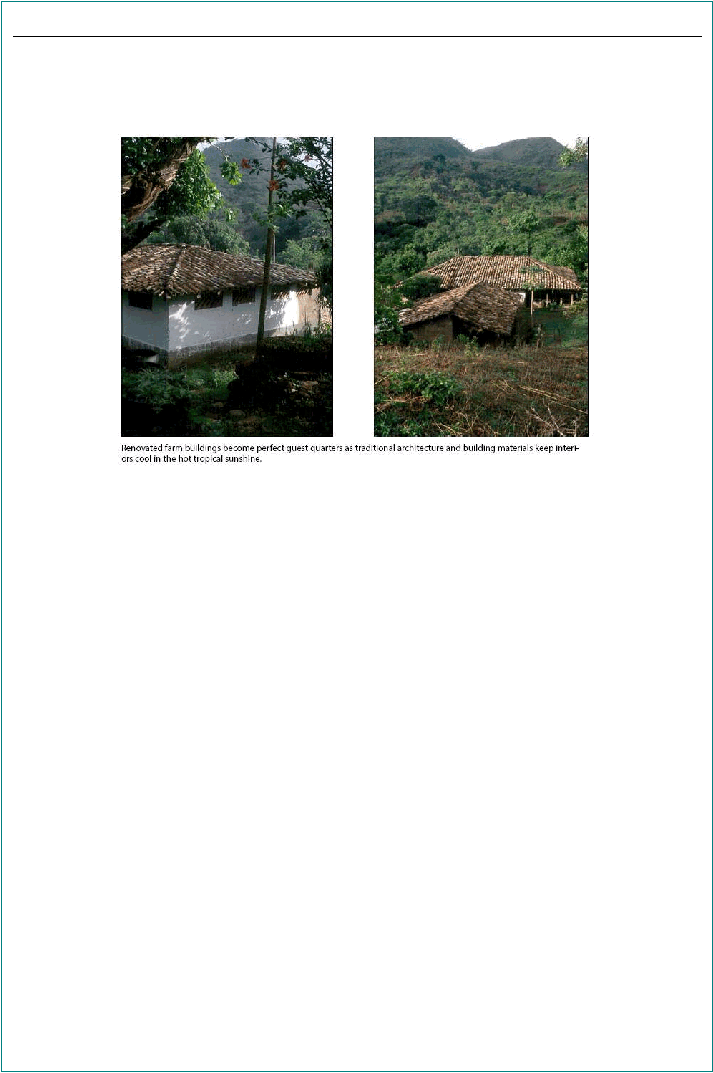
Small groups of visitors can either be lodged in existing dwellings that have been retrofitted to accommodate guests, or in
accommodations that are built specifically for the purpose of lodging small groups of visitors. Whichever the case, the
structures’ exterior should reflect the local architecture. New construction should use local building materials and employ labor
that knows traditional construction methods. For example, adobe is the prevalent building material in El Rincon, Honduras,
whereas wooden structures may be the norm in other villages.
In the Lower Casamance project of Senegal, several villages were outfitted for small groups of tourists who wanted to
experience authentic village life. Small lodges were constructed in four villages, employing traditional design and using local
building materials. The dwellings, often located on the outskirts of the village so as not to disrupt the already built environment,