ECOCLUB, Issue 92
_____
_____
15
In (Osterwalder, 2004) a Business Model Ontology has been developed which may be a very appropriate starting point for our
discussion concerning Ontology. Osterwalder talked of four pillars - according to the Ontology theory - four classes, for which he
created subclasses. Relations exist between these classes and subclasses, and each subclass or term is structured further by attributes.
A brief overview of Osterwalder’s results follows.
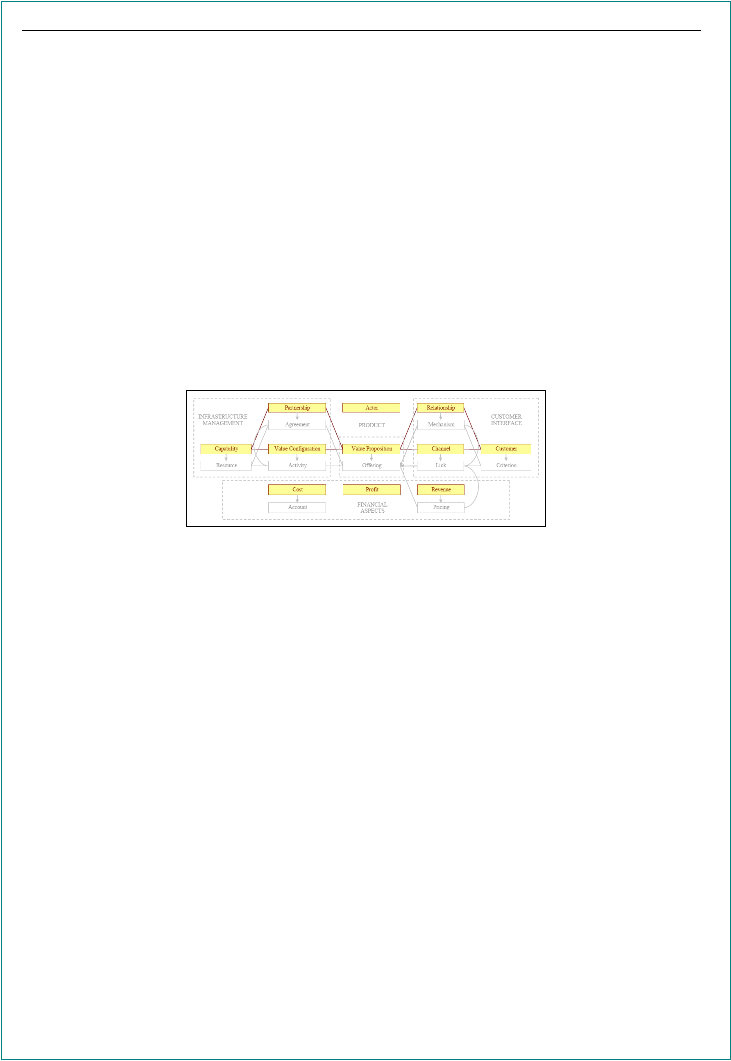
The main goal of the Osterwalder dissertation was to provide an Ontology that allows to accurately describe the business model of a
firm. In the first instance, four main areas are identified that constitute the essential business model issues of a company: Product,
Customer Interface, Infrastructure Management and Financial Aspects.
Next, these areas were broken down into a set of nine interrelated building blocks that allow for the conception of a business model.
While the four areas are a rough categorization, the following nine elements are the core of Osterwalder’s Ontology business model:
Value Proposition, Target Customer, Distribution Channel, Relationship, Value Configuration, Capability, Partnership, Cost
Structure and Revenue Model.
The Ontology Business Model is a set of elements and their relationships that aim at describing the money-earning logic/potential of
a firm. As outlined above, Ontology contains nine business model building blocks, so-called business model elements. Every
business model element can be divided into a set of defined sub-elements. This segmentation allows for the study of business models
on different levels of granularity in more or less detail and according to specific needs. Every business model element can be
described precisely, textually and graphically. In the graphical descriptions the elements and sub-elements are related to each other
through a "setOf" and "isA" relationship (see following Figure 4).
Figure 4
Business Model Ontology (Osterwalder, 2004)
Similarly Ontology will be applied to business strategies and business processes. When applying Ontology for business strategies,
Balanced Score Cards (BSC) should be taken into account. BSC finds disjointed categories (customers, employees, internal
processes, financial results) of strategies which an organisation should follow. Each of these categories may be further categorized
according to common specific characteristics (e.g. business drivers) and so on. Each of these categories and subcategories has
relationships and each subcategory or term can be structured further using specific attributes. Thus, Ontology could be an appropriate
approach for determining business strategies.
Especially when using Ontology for business strategies, important terms such as trust building and legal issues, must be taken into
account, which unfortunately are very often neglected and in doing so many business projects either failed or got past their
completion deadline. Some useful approaches can be found in Kaplan and Norton, (1992) and SBS, (1996).
Finally business processes will be considered. Ontology is well established in this area. Horizontal and vertical business processes are
two different processes. Horizontal processes are for instance procurement, delivering, maintaining, developing, and manufacturing.
Vertical Business processes belong to domains, such as tourism, health care, chemistry, automotive. So as a rule, each of the
mentioned horizontal business processes have a vertical specialization.
RDF/OWL
Meaning is expressed by RDF (RDF, 2006), which encodes it in sets of triples, each triple being rather like the subject, verb and
object of an elementary sentence. In RDF, a document makes assertions that particular things (people, Web pages or whatever) have
properties (such as "is a sister of," "is the author of") with certain values (another person, another Web page). This structure turns out
to be a natural way to describe the vast majority of the data processed by machines.
OWL (OWL, 2006) is a Web Ontology language. Where earlier languages had been used to develop tools and Ontology for specific
user communities (particularly in the sciences and in company-specific e-commerce applications), they were not defined to be
compatible with the architecture of the World Wide Web in general, and the Semantic Web in particular.
OWL uses both URIs (URI, 1997) for naming and the description framework for the Web provided by RDF to add the following
capabilities to Ontology: ability to be distributed across many systems, scalability to Web needs, compatibility with Web standards
for accessibility and internationalization, openness and extensibility.