ECOCLUB, Issue 95
9
THE ECOCLUB INTERVIEW
MART REIMANN
“The main challenge for Tourism in Estonia is marketing and making our
country a better known tourism destination internationally”
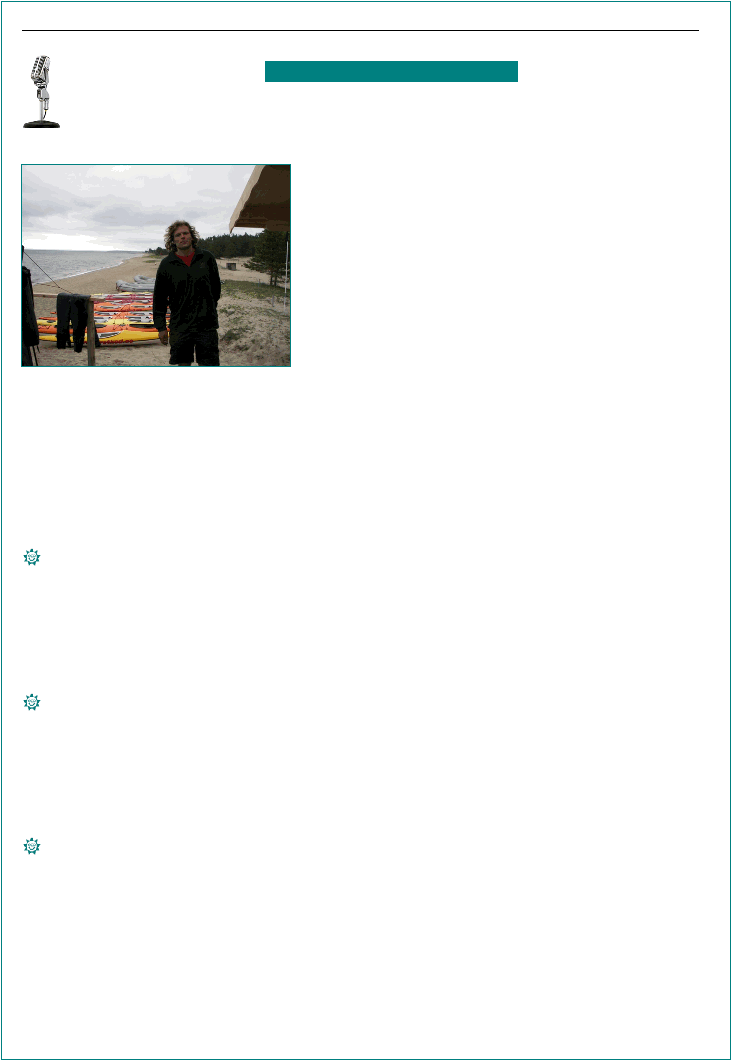
Mart Reimann is an Estonian Ecotourism educator and entrepreneur. He is a
board member of the Estonian Ecotourism Association and has worked as
nature conservation expert in the Estonian Ministry of Environment and
planned recreational areas for state forests. He has been training other
Estonian nature and adventure tourism entrepreneurs, and has acted as a
visiting lecturer of Ecotourism in universities in Finland, Norway, Holland
and the United States.
Mart founded his company Reimann Retked (Web: www.retked.ee ) five
years ago which organises active natural and cultural tours to Estonian
islands with sea-kayaks, to Estonian wetlands with bog shoes, to rivers with
rafts, to forests with walking tours and skies and kicksledges in winter. His
company is also working in ecotourism consulting.
Mart Reimann is head
of the Department of Leisure Sciences at Tallinn University, where he also
teaches several ecotourism and outdoor recreation courses. His department focuses on outdoor recreation research and
education. Mart’s research interests lie in the fields of landscape recreational values, tourism impact on local communities and
visitor behaviour.
Mart Reimann holds an A.A degree in adventure
sports from Garrett College, Maryland, USA, a BSc in Geoecology from
Tallinn University, and an MSc in Physical Geography from University of Tartu. He has been working on his PhD at
the
Norwegian University of Life Sciences and the University of Tartu. His studies and travels have taken him to over 30 countries
around the world but his favourites are cold climate regions like Siberia, Greenland and British Columbia, and the traditional
farm where his family has been living hundreds of years.
The Interview follows:
ECOCLUB.com: Please tell us a few things about yourself, what attracted you to this lifestyle, and what keeps you
motivated
Mart Reimann:
I have had this lifestyle as long as I remember. I grew up in forests and in rural setting where roots and
traditions are important. I liked to have long walks in Estonian nature and long talks with locals already when I was very young.
I have always been impressed by my ancestors’ wisdom who lived in great harmony and respect to nature. They knew very well
how to live in a sustainable way. After travelling and being abroad I just became to value much more this lifestyle I learned
from my parents and friends in Estonia and I got to know that this was called ecotourism.
ECOCLUB.com: What are the main challenges for Tourism in Estonia today?
Mart Reimann: The main challenge is marketing and making our country a better known tourism destination internationally.
Despite that we are historically, culturally and economically very much connected to other Northern European countries, a
shadow of Soviet occupation is still following us and many people in the world associate us more with former Soviet Union
countries and Eastern Europe. Another big challenge is how to keep our authentic and traditional attractions while European
Union regulations are implemented by our eager officials. Provision of traditional food and accommodation in traditional
Estonian log houses gets more and more complicated
ECOCLUB.com:
Estonia is incredibly & densely forested, with a dramatically beautiful coastline, however the Soviet
era
has left lingering environmental problems. From your personal experience as a tour operator, do these
environmental problems affect nature tourism / adventure tourism? Can/does the private Tourism
sector take any
initiatives to repair the environmental damage in the areas it operates, and protect from
future degradation, or is it
purely a matter for the government?
Mart Reimann:
I see negative and positive aspects of the influence of Soviet regime to our environment. Soviet military
reckless behaviour with our nature left polluted areas; our government’s first priority after independence was to clean up those
places. Soviet army closed large areas from public to military trainings, pollution covered relatively small areas, most of the
areas remained untouched and turned to the wilderness. At the moment many our most remarkable nature conservation areas are
former Soviet military training areas. Some military buildings in the deep nature give some extra flavour to the nature tour.
Soviet industry left also many empty buildings, but thanks to our rapidly growing economy and real estate boom most of them
have found owners and also new usage. Thanks to Soviet border guard we could call our coastline a virgin coastline, because