ECOCLUB, Issue 95
13
Central Estonia is the land of bogs, where moose, wild boar, wolf and bear still
survive, along with eagles, black storks, black grouse and many other species. Soomaa
Park (371 km2) , founded in 1993 and a Ramsar area in 1997, contains four large bogs
(Soomaa meaning ‘bogland’), separated by forests and rivers. There are many well-
prepared hiking trails and board walks which do however get slippery. Berries, high in
vitamins, grow all along the hiking trails,
and even the official Park handout guide
encourages visitors to pick them, as for mushrooms, with the
exception of breeding
time of rare birds. The area is famous for its 5th season, when all areas are flooded
from the melting snow. It was such an expected and regular occasion,
that locals
waking up in a flooded bedroom would just say “we have a guest in the room”.
Flooding was an opportunity to take time off from work and meet the relatives. The
biggest flood occurred in 1999, when the water rose over 4 metres. This has preserved
an archaic lifestyle and ancient watercraft called haabjas – canoes dugout canoes made
from a sigle aspen trunk. First the log is cut, hollowed and expanded, then warped
bows of pine roots are placed inside to stabilise it, and finally the boat is tarred (Watch
video at). Log boats are traditionally rowed while standing, and the biggest could carry
13 passengers. Thanks to the creation of the park, a new generation of boat-makers has
emerged and log boats are a frequent sight in Soomaa rivers. The flood-plains and
bogs of Soomaa are a habitat for species such as, common crane, black stork, golden
eagle, and less spotted eagle, eagle owl, great spotted woodpecker, black woodpecker,
while vast undisturbed forest areas help preserve brown bears, wolf, lynx, otter, roe
deer and elk. Overall, in Soomaa 524 species of vascular plants can be found, 172 bird
species, and 46 mammals species.
In South Estonia, beavers frequently alter the Estonia-Latvia border, as they dam up
the streams that demarcate the border line!
The Piusa Sandstone Caves in south-eastern Estonia, are man-made caves to mine
sand for the glass industry, are now closed, but are popular with some 3,000 bats of
5 bat species, the biggest colony in northern-europe, and tourists.
Not all is rosy. There are serious
ecological problems such as air pollution
from oil-shale burning power plants in
northeast Estonia, contamination of soil
and groundwater with petroleum products,
lingering chemicals at former Soviet military bases; coastal sea water pollution. coastal
pollution, lake eutrophication and weed overgrowth from organic waste.
Hunting
Tourism is also encouraged, with 24 bears, 30 wolves and 81 lynxes killed in 2002
according to official figures. On the other hand, environmentalism is making inroads,
with the Estonian Green Party and entered the parliament for the first time in 2007 with
7% of the vote. Inter-ethnic tensions which grew in the Spring of 2007 over the
decision to relocate a soviet-era monument and made rare world headlines from this
otherwise very peaceful, cool and e-trendy country, better known as the birthplace of Skype, have now thankfully subsided.
When in Estonia, a visit to the old town of
Tallinn (pop. 434,000), one of the two Unesco
World Heritage sites, is also a must. Famous
sites include the Town Hall, one of the oldest
preserved Gothic secular buildings in the
world, dating to the 15th century, and a chemist
shop in continuous operation since 1422, and a
whole street with perfectly preserved 600 year
old Mansions belonging to Hanseatic League
Merchants. The other World Heritage site is
the Struve Geodetic Arc, a chain of survey
triangulations stretching from Norway to the
Black Sea, but there are also candidates like the Baltic Klint, Kuressaare Fortress on
Saaremaa Island, Soomaa National Park.
The ecotourist will find many activities in Estonia, including archeological and
prehistory tours, bicycle riding,
bird watching, bog-walking, canoeing, sea kayaking,
culinary lessons, folkloric and singing events, hiking, homestays, horse riding, kick-
sledding, botanic tours, forest-hiking, seabird ornithology, organic farm stays,
photography tours, rafting, sauna culture, to the famous Tartu Maraton, a cross-county skiing, running and mountain biking
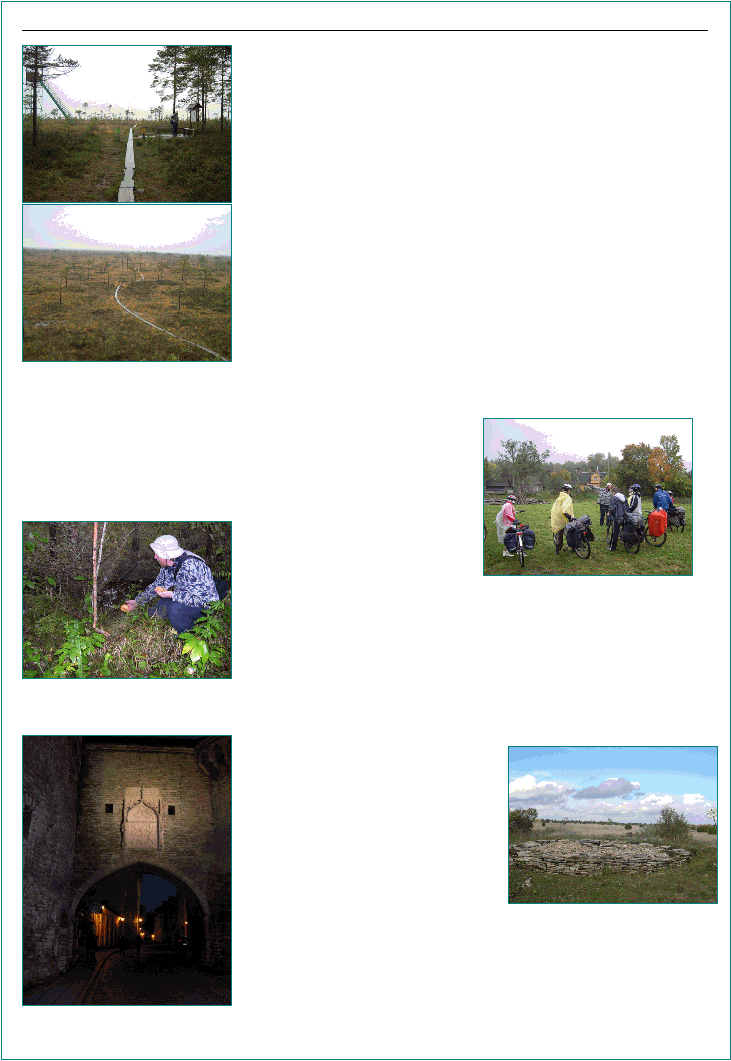
Not the Savanna, but the unique Bogs of
Soomaa, a sort of vast, wet sponge!
Soomaa Bikers’ Paradise: Flat, Green
Know your mushrooms
Entrance to old Tallinn
Rich in history: Ancient Tombs