
by Pina Wu, ECOCLUB.com Correspondent
 About the Author About the AuthorPina Wu is an Environmental Services Professional based in Taipei, Taiwan. Her specialities include Urban Planning, Community Engagement and International Development. She has a Master in Public Policy and Urban Planning from Harvard University and an M.S. in Building & Planning from National Taiwan University. She currently teaches Environmental Education and English for Tour Guiding in Wenshan and Tainan Community Colleges. |
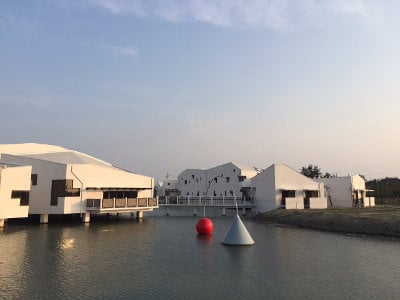
 On January 13th, 2016, Taijiang National Park (Map) unveiled its newly completed administration office and tourist centre in Tainan, southern Taiwan. Three weeks later it withstood an 6.4 earthquake which killed 117 people and caused widespread damage particularly in Tainan. The building, in the heart of Sicao wetland, a Ramsar site, is an example of modern stilt architecture, built over the waters of a former fish farm. When visiting Taijiang, one appreciates a serene scenery: the tidal shore is dotted with mangrove forests, birds fly over the water in search of the day’s catch, local fishermen check their nets in the pond and women pick out oysters from their shells under the trees in the fishing villages. Few visitors can imagine or comprehend that twenty years ago, there were plans to develop an industrial zone with new townships, an oil refinery, a harbour and an airport in this very location. Those plans were only dealt a final blow in 2009, when Taijiang National Park was formally launched to protect the highly-endangered black-faced spoonbill. It has a total area of 39,310 hectares, of which 34,405 ha is covered by water. Taijiang NP was the eighth national park in Taiwan (out of a current total of 9) and the first that set the wetland ecosystems as the main conservation subject.
Wetlands dot Taiwan's west coast where villagers historically had been relying on fishing, salt-making and agriculture as their main livelihood, but were struggling due to the decline in the fisheries sector. Because of their low property value, wetlands were viewed by developers as empty spaces and soon power plants, petrochemical plants, steel mills and landfills also began to dot the coastline. By 1993 around 12,000 ha of wetlands had already been covered by industrial complexes.
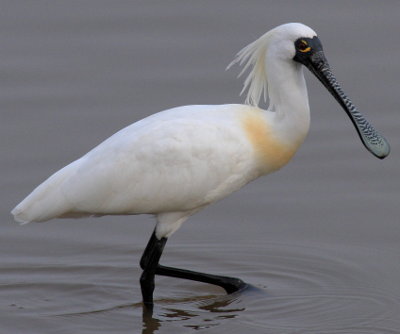
The Black-faced spoonbill is a migrant water bird confined to coastal east Asia and especially in the Taijiang area. In 1993, its world population totaled only 1200, of which two thirds wintered in Taijiang, before embarking on a flight of 2000 km to North Korea and Northeast China. That year, a new development by the name “Binnan Industrial Complex” was proposed for the Taijiang area, which would have been one of Taiwan's largest industrial ventures. Despite support from some local villagers eager to sell their land to developers, the development was put on hold after strong opposition from an alliance of Bird lovers, fishermen, entrepreneurs, grassroots groups, international NGOs and a few key legislators which campaigned to make black-faced spoonbill an iconic conservation species.
Official Tajiang National Park video
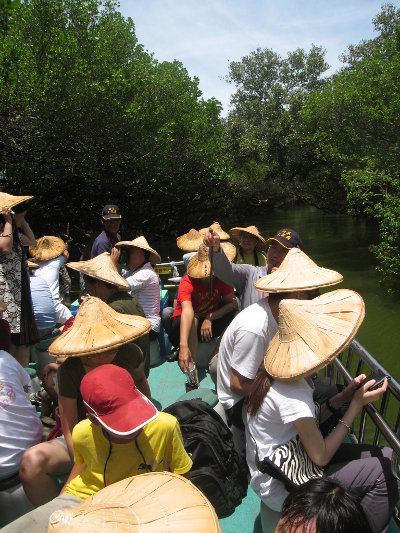 An initiative called SAVE International was also founded in 1997 by academics and students from the University of California, Berkeley and National Taiwan University and further raised international and local awareness about the bird. In 1998, in a single birdwatching station, more than 25,000 tourists were recorded and the deserted coastline slowly emerged as a day-trip destination for birdwatching, and for educational wetland boating trips. The conservationists pointed out that the marshlands were essential to the natural balance, supporting biodiversity and fish stocks, controlling floods and purifying water and protecting the largest wintering site of the endangered Black-faced spoonbill (Platalea minor). They proposed setting aside much of the wetlands as a preserve and promoting ecotourism as an economic alternative to industrial development. In 2002, the first Black-faced Spoonbill Sanctuary was established in the Zengwun estuary area. Seven years later, after a battle that lasted for 16 years, the creation of Taijiang National Park finally puts an end to the Binnan development project, leading the area towards an alternative, sustainable development path.
The parks' area features tidal flats, sandbanks and wetlands that provide a habitat for diverse flora and wildlife. Salt fields, lagoons, fish farms, mangrove forests constitute a wide array of ecosystems. The area is also rich in culture and history. Within the boundary of the National Park, the marine area covers the main shipping route taken by Taiwan’s earliest immigrants from China over 400 years ago. Many Han migrants from Mainland China sailed across the Taiwan Strait to settle in the Taijiang area, forming the early settlements. Taijiang was also the centre of activity for Dutch merchant ships during the 16th and 17th century, bearing witness to Taiwan’s presence on the international stage in the Age of Discovery. Besides the Black-faced Spoonbill Ecology Centre other top tourist attractions include the Sicao Mangrove Green Tunnel, Salt Museum, and Cigu Lagoon. Local bird societies, wetland conservation groups, cultural groups and the National Park itself also lead guided tours or interpretative services. Currently, main tourism activities include boating, canoeing, birdwatching, stargazing and cycling. Visitors also come to worship and attend festivals held by the local temples. There are many homestays, restaurants, and cafes. According to Ministry of Interior figures, tourist numbers rose from an estimated 456,000 in 2011 to from an estimated 456,000 in 2011 to 782,356 in 2015.
Within and nearby the Park, there are traditional fishing villages. Since its establishment, Taijiang National Park has prided itself as being a “second-generation” national park that breaks the dichotomy of environment conservation and economic development. For this purpose, in 2012, the National Park founded a “Wetland School”. It is a collaboration between local university and several elementary schools to develop curriculum program of the environmental education. Several sets of environmental education lesson plans have been developed to let the students interact with the local fisherman, to learn about history through treasure hunting, to experience wetland ecology, and to understand concepts such as sustainable seafood. As one member of staff explained “in these programs we have tried to involve local people, utilizing their knowledge and skills. These are pilot programs. We hope in the future there can be more community-based ecotourism activities in the area.”
The National Park also tried to create so-called “Home Guardian Circles” with 14 different nearby communities. The idea was to conserve the ecology through local partnerships, and develop diverse tourism programs based on each community’s unique characteristics. Unfortunately, this project appears to be inactive these days, perhaps due to an ageing and not-well educated village population and, as alleged in a local event, the lack of a local advisory board representing the villages as had been promised. The Park authorities still try to build relationships with the local communities by organizing tours in local markets, conducting "green map workshops" to map local cultural and ecological resources and other initiatives. For example, in Siangong Community, through working with local NGOs, residents, artists and student volunteers participated in designing and building a small plaza utilizing local reuse materials, transforming a blight area with public arts and murals. [PHOTO]
Huan-Chih Su, a local politician and a key backer of Taijiang NP, argues that tourism, both requires funding and cannot substitute the lack of public funding in other sectors: “the area has suffered from insufficient public investment in the past. With ecotourism, there still needs to be public spending to create the basic infrastructure” he stresses. Indeed, Taijiang area's nickname is “land of salt” a harsh coastal environment with a barren landscape. It has scorching sun in the summer, and strong wind in the winter. Roads, facilities, walkways, services stops, all are needed for the area to become more tourist friendly. The communities here traditionally have been poor and poverty persists. Local temples are among the only social entities with enough resources to invest in facilities and infrastructures for tourism development. Sihcao Dazhong Temple, operates a boat tour that takes visitors into the Mangrove Green Tunnel, which has now become the most famous attraction in the Taijiang area. Xi Huang, the man pioneering the boat tour program, believes there is great potential if the temples can become a base for education in ecotourism. “The ethics in religion can be transformed into land ethics and caring for the lives around us.” as he put it. Local Luermenma Temple and Chaohuang Temple in the past have also developed workshops and courses, educating people about the ecology, culture and history in the area.
Undoubtedly, the creation and operation of Taijiang NP have benefited the spoonbills: according to the Chinese Wild Bird Federation (CWBF) their population has steadily risen from 427 in 2000 to a record 2,034 in the winter of 2014-2015. Taijiang seems to have been spared from an unsustainable petrochemical future, however conservationists should still be on guard to ensure that it will develop sustainably as a genuine ecotourism destination. As in many protected areas around the world, there are land-use conflicts. SAVE International, who are still active in the area, recently expressed alarm over plans to create a “love theme park” and “a small-craft airstrip for wealthy aero-tourists" near one of the spoonbills' core roosting areas, without any formal environmental review.
Formosa News Video Report, 11 August 2015
In addition, there is a conflict between aquaculture and conservation (as documented by a Formosa News video report from August 2015): the abandonment of traditional shallow-water sea-farming practices, and the switching from milkfish to clams which do not need low water-levels make the water too deep for spoonbills who prefer a shallow depth of 20 cm in order to easily find crustaceans and tiny fish. The Park is currently trying to encourage traditional milkfish cultivation practices and even promotes a "Black-face spoonbill brand" canned milkfish.
Edited by Antonis Petropoulos
All rights reserved, ECOCLUB S.A. (2016)