
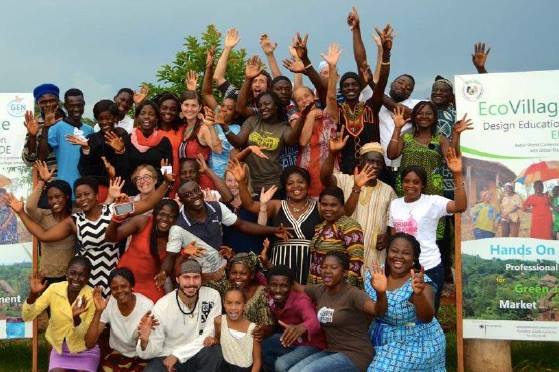
Marrakesh, Morocco, 14 November 2016:
An inspiring, grassroots-focused COP22 side event took, entitled "Improving Nationally Determined Contributions (NDCs): Ecovillage Development, Energy Access and Zero-Carbon Societies in Africa, Asia and the European Union (EU)" was presented by the Global Ecovillage Network (GEN), the International Network for Sustainable Energy (INFORSE) and the Nordic Folkecenter for Renewable Energy (NFVE) in Marrakesh on 11 November.
It was co-moderated by Kosha Anja Joubert, Executive Director, GEN, Gunnar Boye Olesen, INFORSE, and Preben Maegaard, Executive Director, NFVE, and focused on ways through which local solutions may lead to ambitious NDCs, provide energy access and improve livelihoods.
Highlighting intentional, traditional and urban ecovillages, and noting that GEN reaches out to 100,000 communities worldwide, Joubert urged considering new concepts of wealth, celebrating human culture and rebuilding solidarity in local communities.
Tim Clarke, European Network for Community-Led Initiatives on Climate Change and Sustainability (ECOLISE), underscored social inclusion, local ownership, employment generation, and access to untapped resources and indigenous knowledge.
Focusing on children, Linda Kabaira, GEN-Africa, Zimbabwe, presented on efforts to build resilience in a changing climate by greening schools. Highlighting that his country has negative net carbon emissions, Chencho Norbu, National Environment Commission Secretariat (NECS), Bhutan, presented national policies pursuing, inter alia, organic farming.
Kavita Shriya Myles, INFORSE South Asia, discussed a pro-poor approach to universal clean energy access and a compassionate approach to improving livelihoods. Describing ecovillage development (EVD) as a climate solution, Dumindu Herath, Integrated Development Association (IDEA), Sri Lanka, underscored national initiatives, including the development of 10,000 climate-smart villages.
Shovana Maharjan, Centre for Rural Technology (CRT), Nepal, discussed EVD contribution to achieving national and international goals and targets, highlighting capacity building and awareness-raising campaigns. Mohammad Mahmodul Hasan, Grameen Shakti, Bangladesh, addressed existing mitigation solutions at the national level, including the solar home electricity programme for off-grid villages, improved cooking stoves, biogas plants and organic farming. Underscoring the transboundary, cross-sectional and cross-cutting nature of climate change, Santosh Patnaik, Climate Action Network (CAN) South Asia, urged for regional cooperation to overcome climate vulnerabilities.
Maegaard stressed that, by 2030, 58% of all new electricity generation capacity will be based on renewables. Stressing that the science behind the Paris Agreement clearly recognizes the need for net Zero-Carbon emissions, Paul Allen, Centre for Alternative Technology (CAT), UK, identified food, transport, buildings and energy as the four key sectors, and underscored that by "breaking existing climate silence", people forge a collective identity.
Highlighting community power for the transition to 100% renewable energy, Leire Gorroño Albizu, NFVE, presented the case study of Hvide Sande in Denmark, where the installation of three community-owned wind turbines led to economic stability and development, job creation and self-sufficiency.
During discussions, participants addressed, among others: emissions related to meat consumption; reduction in beef consumption and potential effects for communities that are based on animal husbandry; ways to overcome water scarcity problems; inclusiveness under mitigation; and ways to connect the regional, national and international levels.
More information: