
By Pina Wu, ECOCLUB.com Correspondent
|
|

Even though Taiwan may not come across as a top destination for ecotourism, the island actually has a biodiversity density (number of species per square kilometres) which is second only to Madagascar's. Taiwan is situated at the Western Pacific Rim, lying at the confluence of two tectonic regions, the Eurasian and Philippine Plates. It encompasses four climate zones (tropical, sub-tropical, temperate, and frigid) and has the highest density of mountains over 3000 meters in the world.
Heavily industrialized and populated, Taiwan, like most other highly-developed economies, has achieved economic success at the expense of its environment. With the gradual growth of environmental awareness, the government started to raise the bar for environmental protection, so far creating 17 Wildlife Reserves, 35 National Forests, 19 Environmental Protected Areas, 9 National Parks, and 13 National Scenic Areas. With the "Wetland Conservation Act" enacted in 2013, and the "Coast Act" currently going through legislation, nearly 20% of the land area in Taiwan is under some protection. Taiwan is surrounded by a coastline of 1,172 kilometres only a small portion of which is not transgressed by the highway network and remains natural.
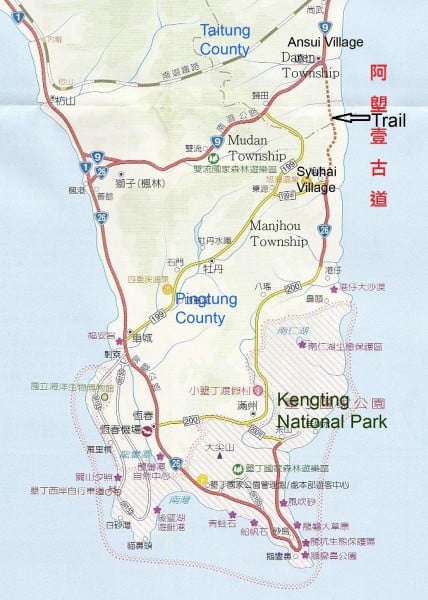
 In 2006, a proposed 11.8 km highway project in south-eastern Taiwan ignited "the battle for the last 1% of natural coastline". The majority of local people, around 3,000 in various villages along the A-Lang-Yi trail, mostly employed in the public sector and in agriculture, lobbied in favour of this highway project. The remoteness of the south-eastern region has delayed development as people had little access to hospitals and schools and there was a lack of local economic opportunities. Below is a map of the area. In the south you can see Kenting National Park, visited by over 6.5 million each year. So supporters of the highway argued that it could bring tourists directly to the region up north.
On the other hand, environmental groups saw the area's remoteness as an asset for biodiversity. With the natural coastline forest remaining intact, the area had become an important habitat for wildlife, with over 46 protected species including the endangered coconut crab and green sea turtle. Furthermore, the coastline used to be a historical travelling route used by the indigenous people over the centuries. Missioners, traders from the west, and people from mainland China had all set foot on the A-Lang-Yi trail in the 19th century during the exploration of what was then called 'Formosa' island. Conservationists argued that the proposed highway project would not only destroy the delicate ecosystem in the area, but also ruin the heritage trail. To make things more complicated, the A-Lang-Yi trail belongs to two counties. Taitung, the county in the north felt Pingtung county had no right to declare the region an environmental protection area on its own behalf and appealed to the central government to revoke the decision.
One other possible reason for creating the highway was that in 2007, Da-ren, the township north of the trail was confirmed to be selected as a potential site for radioactive waste storage because it is a remote and sparsely populated place. Environmental groups suspected that the real purpose of the highway was to connect the nuclear power plant in the south to the storage site.
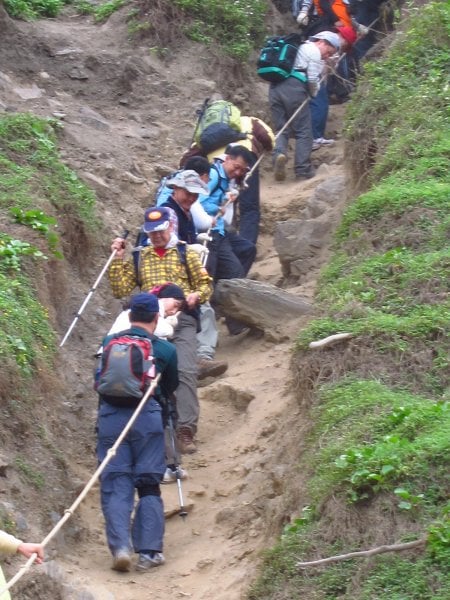 An Environmental Impact Assessment review of the highway project was set up in 2010. In order to generate more public awareness, "Pingtung Environmental Protection Union", a local NGO, held eight sessions of fam tours, providing interpreted walks on the ecology and history along the trail, between March and May 2011. The tours attracted more than 250 people in total. Media reporters, scholars, students, opinion leaders all came to the area and spoke on the issue, while over 50,000 people signed a petition to conserve A-Lang-Yi trail. All of a sudden, this little known remote trail had become the centre of attention nationwide. Visitors trickled in the area and many would spend a night in the local communities as it can take up to 7 hours to walk the whole trail.
Although a local majority were protesting against conservation and for the new highway there were exceptions: in Ansui, an indigenous village at the north end of the trail, a local school teacher was advocating for preserving the trail. The village had also organized ecotourism tours since 2008 (still ongoing) that provided in-depth cultural experiences and included walking the A-Lang-Yi. People teamed up to form an ecotourism service centre, and they even agreed to a collect a small common fund. But according to a study by Huang Chung-Ren1 the villagers found it hard and tourism did not create full-time jobs.
In order to give local people a different vision for development, environmental groups including small local groups such as Syuhai Community Association and Pingtung Environmental Protection Union and national NGOs such as the "Thousand Mile Trail Planning Centre" begun in 2011 to host workshops and training sessions to promote the idea of slow travel and ecotourism. The environmental groups were trying to prove that there is a market for ecotourism in the area and that, if done right, ecotourism could bring more economic gain to the community than the highway development. In public debates, such rationale was explained in numbers: an ecotourist on average would "spend USD 70 on food, lodging and tour activities per day" according to Hung Xiang-hui2, the chairman of Pingtung Environmental Protection Union, and the leader of the preservation campaign. Hung estimated that there would be 300,000 slow tourists in the region per year, that the communities could collect a revenue of over USD 7.5 million per annum and that this would be higher than under the highway scenario, in which 4.95 million travellers would just pass by and spend only an average of "USD 4 per person" while leaving the area with the impact of traffic and unregulated development. It is unclear how Hung estimated these numbers although in one TV program Hung mentioned that he used statistics from the Tourism Bureau of Taiwan.
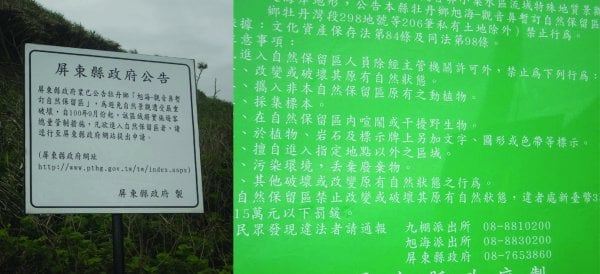 Finally, in 2012, the Directorate General of Highways decided to postpone the highway project while the local Pingtung Government declared A-Lang-Yi Trail as a Protected Area. A cap of 300 visitors per day was established to protect the area from overcrowding. Visitors had to ask for permits, free of charge, from the Pingtung County website3. In addition it was obligatory for visitors to hire a certified guide with a standard fee of USD 100. The guide, which could take up to 20 people in one group, was usually a local thus generating local employment opportunities. Currently there are 24 guides on duty, a majority of whom are locals. The local government also set up a compulsory ecotourism guide training program for local guides which has so far been completed by 68 guides. A new medical emergency station was built and bus services expanded leading to better medical and transportation services to the local communities. It was also announced by Magistrate Tsao Chi-hung in 2011 that, in the future, an "entrepreneurial fund" would be set up to encourage local ecotourism start-ups but this has not yet materialised.
Currently there is a modest but steady stream of visitors to the area. According to the Pingtung County Government website, the 300 people quota is often used-up on the weekends but there are only 30 to 100 people on the trail on the weekdays. The scale and types of ecotourism activities are still very limited. Most of the tourists are hosted by individual homestays and private tour companies haphazardly, with little relations with the community as a whole. The homestays are run by the locals but there is little coordination, and certainly not the scale and quality that could attract "300,000 tourists per annum" as envisioned by the conservationists. Furthermore, the County Government does not have enough personnel nor funding to guard and maintain the trail and there is a lack of parking lots, rest-rooms, and trash cans. All along the A-Lang-Yi trail, the path is suffering from erosion, with trash scattered by the roadside. In facing the many challenges, the local environmental groups are hoping to attract more public and private investors and tour operators to the area to work with the locals so as to create a better model of ecotourism development.
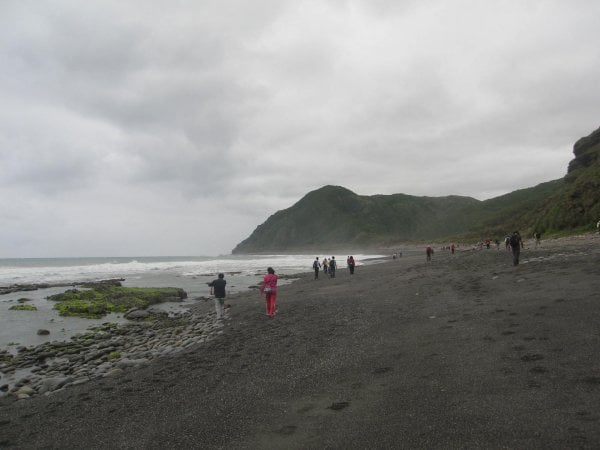 Still, the case of A-Lang-Yi is considered by the environmental groups, civic sector, academia as one of the big successes in Taiwan's environmental protection movement as it brought the heated "development vs. conservation" debate to the centre of people's attention and proposed Ecotourism as the solution. However, conflicts between the local communities and the environmental groups still linger. Many local people, especially from Manjhou and Mudan townships, feel that the conservation of the area was a "top-down" decision that was forced upon them, hampering their right for development4. What the government has done has not compensated their losses and was not enough to jump-start ecotourism development in the area. As general elections are to be held at the end of 2014, one wonders if the current conservation policies will be continued. One candidate has already promised to continue the highway project by removing the environmental protection status of this area while another candidate remains ambiguous about this issue. Thus, the fate of A-Lang-Yi Trail is uncertain.
There are alternatives and solutions: the highway can follow a longer route circumventing the trail, the weekend quota or permit price could be increased, while some of the tax funds originating in environmentally-destructive industries elsewhere in Taiwan could be used to subsidise the local economy so as to encourage conservation. But it is clear, that Ecotourism cannot be just a slogan for conservationists; it also needs to make economic sense for the local people so that they will in turn support conservation in the long run. There is a need for coordinated efforts to create successful ecotourism models in Taiwan, a need for more expertise and exchange on information on best practice cases.
Notes:
1. quoted in Sustainable Tourism Development in an Indigenous People's Village: A Case Study on A-Lang-Yi Tribe, Huang Chung-Ren, 2012
2. see http://alangyi.blogspot.tw/p/blog-page_25.html and in the book "Walking along A-Lang-Yi Trail"
3. see http://175.99.86.233/syuhai/index.php?page=apply
4. UDN.com News, 2011.07.12
References:
Website: http://alangyi.blogspot.tw
Book: Walking Along A-Lang-Yi Trail, Pingtung Environmental Protection Union, Jade Mountain Publishing, 2014