We have come to that time of year again when Punta Gorda (Peini in the Garifuna language) becomes the centre for activities surrounding the November Garifuna celebrations. While the weekend of Friday 19 celebrates the reenactment of the arrival of the Garinagu on the coast of Belize, the previous weekend is the focus of musical celebrations with the fifth annual Battle of the Drums. There is a new element added this year for the Battle of the Drums’ fifth anniversary. Friday night at the PG Sports Bar will offer Garifuna food and music. The food will be prepared by chefs from Machac Hill Lodge and the Radisson Fort George in Belize City using traditional Garifuna cuisine and adapting it to a contemporary style. Live music performance will feature Paul Nabor, Mario and the Umalali Group, Lloyd, Nuru, Adrian the Doc and Lascelle Martinez. The drumming contest on Saturday will take place on the Punta Gorda Football field, weather permitting. This year the contestants are back up to nine bands. Georgetown is a new entrant from Belize and the international bands are from Livingston across the pond in Guatemala and Baja Mar in Honduras. This year in addition to the drumming prizes...
ECOCLUB Blogs™
The Economist is hosting a debate and welcoming the public to vote on whether or not they think biotechnology and sustainable agriculture are complimentary. http://www.economist.com/debate/debates/overview/187 [Suicide seeds. Starve the world. Any other great ideas from the biotech industry?]
At a time of growing environmental and economic crisis the 'capitalist lunacy' of golf, in the words of Bernard Shaw, is becoming more evident. Ironically, in Cuba, Golf developers, encouraged by recent 'economic liberalisation' announcements are making their own plans... In his regular weekly 'Alo Presidente' TV Show, Hugo Chavez has recently hinted that some of Venezuela's golf courses would be expropriated to be used for other purposes, along with 'good land' that has been abandoned. Stating the obvious, Chavez, who has in the past called golf a 'bourgeois sport' pointed out that it was "an injustice - that someone should have the luxury of having I don't know how many hectares to play golf and drink whiskey and, next door, there's misery and children dying when there are landslides". The comment followed the landslides of October where many people died in shanty towns and is also related to Venezuela's acute housing shortage with an estimated two million homes needed. 9 golf courses, many of which in oil-producing regions catering for Venezuela’s oil elite, have been shut down in Venezuela since 2006. Ironically, in Cuba foreign developers are planning more courses, with some of the recent economic 'liberalisation' changes being linked...
Crete's Culinary Sanctuaries is offering partial scholarships for professional researchers and college students for our May and June 2011 public seminars. The schedule: http://www.cookingincrete.com/Schedule.html Deadline to apply is December 1, 2010. Contact us for more information. Please use subject line: Seminar Scholarships info[at]cookingincrete.com
Greetings Everyone, FYI, my paper submitted to various international conferences focusing on cultural-natural heritage, tourism, sociology, sustainable organic agriculture and traditional cuisine. To me, all of these topics are interrelated and comprise our work in Crete. As those of us actually working in the field of ecotourism/sustainable tourism already know, it's impossible for us to travel the globe to speak about our work at conferences. Time and money is a major barrier to get the word out about small-scale projects. The media is in the dark if they don't know our projects exist. And we are at the mercy of people that present case studies they have not personally implemented or even experienced. Usually those case studies are about very large-scale projects that are heavily funded. That leaves the majority of crucial and worthy projects out of the media loop and the traveler's radar. So this paper was one solution -- when I could not attend conferences, I at least submitted it in the hopes that it would be included. And it was most of the time, thankfully. I suggest that all small-scale ecotourism practitioners consider doing the same. Your voices should be heard at conferences about your work, whether...
The Obama administration, may have slightly loosened the travel ban in April 2009 by allowing Cuban-Americans to travel freely to Cuba, but otherwise has made little progress in lifting or at least loosening "El Bloqueo", the 50 year old & cold war trade and travel embargo, imposed by the world's most powerful state against a small island nation. The travel ban already has plenty of holes as it is condemned at the UN each year by all the world's countries (except Israel) and is also increasingly ignored by many US citizens travelling via Canada or Mexico, or, officially under humanitarian or educational cover (a "professional research general license"). Ironically, the travel ban has affected and distorted the Cuban Tourism model, with resorts seen as a last resort after the collapse of the Soviet Union and the abrupt end of soviet aid. (on the contrary the solution in agriculture was ecological with urban organic agriculture thriving) Low-cost package tourism from Europe led to an overreliance on foreign (transnational) built and operated resorts. A similar travel ban was in place against Vietnam and Laos, now long gone, although their communist systems are not, at least nominally. Many golf courses and luxury resorts are...
1. Introduction 10/10/10 International Day of Climate Change was celebrated in Booni, Chitral, Pakistan, through the facilitation of Destination Management Organization (DMO) Chitral and 350.org. The theme of the day was 'Breaking of Booni Glacier, Its Relation to Climate Change'. As many as 500 people from different walks of life participated. The day has had significance for the people of Booni as they have recently witnessed a flood destroying their valuable property and causing them major health problems, psychological twists and infrastructure disruption. 2. Objective The objective was to join the worldwide communities in highlighting climate problems—breaking of glacier, untimely melting of snow, frequent floods and unpredictable climate conditions—in the Hindu Kush Mountains. 3. Speeches To begin with, speeches highlighting the prospects of climate change in the Hindu Kush Mountains were delivered. Mr Sadruddin, the principal of Orion School of Learning (OSL) impressed upon the participants to save the Booni village by protecting natural environment. This challenge could be successfully tackled by offering environmental-friendly education/values to children within the family right from their childhood. In turn, this will make the task easier for teachers, once they are admitted to schools. He also said that ecology/ natural biodiversity had to be included...
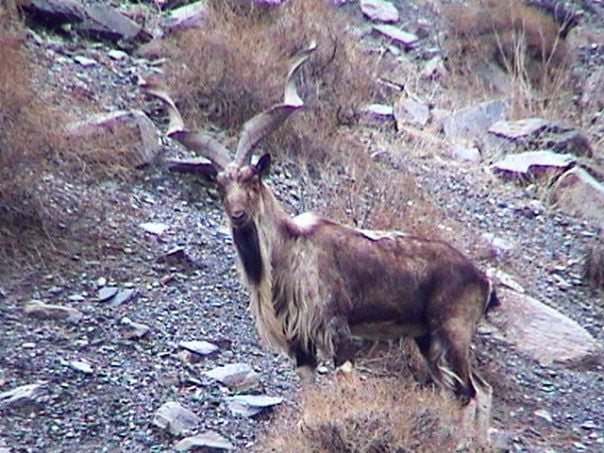
The unique mountain goats (Markhor) were at the verge of extinction in Chitral at the beginning of nineties before the World Conservation Union (IUCN) started biodiversity conservation project in Chitral in collaboration with Wildlife Department Chitral to preserve the population of markhor. As a result a number of conservancies were established and notified by the provincial government and conservation efforts were launched with the local communities already organized by AKRSP in majority areas. Within a short period of time 5-6 years trophy hunting was introduced as wildlife conservation tool by the Khyber Pukhtunkhaw Wildlife Department, which was well received by the communities. The years and price of trophies over the year are as follows: In 1999 two trophy hunts were carried out in Thushi Community Game Reserve Chitral and each Markhor hunt was auctioned at 18,000 USD. By the year 2000, the markhor auction went up 25,000 USD and with each passing year it continuously increased and reached 45,000 USD per markhor in 2005. The figure of 2008 show that a markhor hunt in Thushi was auctioned up to USD 80,000. The last time price of the trophy in 2009 went upto USD 85,000 The interesting aspect of this...
From The Green Connoisseur by Alice Julier, September 2010 "Crete’s Culinary Sanctuaries is a unique, successful, and beautiful approach to sustainable tourism." http://thegreenconnoisseur.com/c/travel/eco_destinations/crete's_culinary_sanctuaries.html “Hotels don’t make a place special. The residents and natural beauty do,” says Nikki Rose, founder of Crete’s Culinary Sanctuaries, an innovative program of sustainable agro-tourism that works to preserve the growing traditions, foods, and cultural practices of this wonderful Greek island. The pleasures of travel are deepened when tourists act responsibly as visitors to ecologically fragile landscapes. But while the overdevelopment of many popular travel destinations has created a host of eco-alternatives, true sustainability is only achieved when locals are provided with the means to preserve and enhance their cultures, as well as their natural resources. For many destinations, the only sound choice truly supports the land, it’s products, and the local economy. An expert in the field, chef and certified educator Rose has been working worldwide towards this goal since 1998.
Now Government has taken follow up on river sand issue and this type of activity is under control. But youngsters loosing life frequently as they don't have the awareness of rivers condition. Jojo Paul