

You'll enjoy this October conference with the world's leading bear researchers http://www.bearcaregroup.org/ Situated in Banff National Park, you'll also get the chance to see bears in their natural environment. I'll be speaking too!
You'll enjoy this October conference with the world's leading bear researchers http://www.bearcaregroup.org/ Situated in Banff National Park, you'll also get the chance to see bears in their natural environment. I'll be speaking too!

PESHAWAR: The Wildlife department has sold permits for hunting of four Kashmiri Markhors (wild goat with spiral long horns) under the Trophy Hunting Scheme. "We have sold permits for the current hunting season, starting from December to March, to an outfitter, Shikar Safari Club," informed Chief Conservator Wildlife Department Saeeduz Zaman while talking to this news agency on Tuesday. He revealed that four permits have been sold at a total value of $2,86,000. Giving further details, Saeed said, two permits were sold for hunting Markhor in Tooshi Shasha game reserved in Chitral for $80,500 each. Similarly, one permit was sold for $70000 in Gahirat game reserved in Chitral while the fourth one was sold for Kohistan district (Kaigah Game Reserve) for $55,000. The chief conservator said sale of these permits were made through auction. The department sought bids from hunters-outfitter for hunting of 10 Himalayan ibexes and four Kashmiri Markhors. "Advertisements were floated in the press and also put on websites of international organisations dealing with wildlife for attracting maximum number of hunters, he added. After completion of bidding process, permits were given to the highest bidder, Shikar Safari club. He informed that in the current year no bid was received...

<p> <img alt="" src="https://ecoclub.com/images/64/dolphins.jpg" style="float: left; margin: 5px;" />It is 72 years since shrude businessmen in Marine Studios dolphinarium in Florida discovered that dolphins could be taught to perform tricks, and four years since the UN Year of the Dolphin 2007, when scientific evidence surfaced that dolphins are human-like, self-aware, intelligent beings and <a href="http://www.indefenseofdolphins.com/">‘nonhuman persons’</a> . In the European Union alone, there are 34 dolphinaria, hosting 280 captive dolphins, whales and other cetaceans, many of whom were not born in captivity but are actually products of poaching and smuggling. There are another 26 dolphinaria in non-EU European countries and many more in the United States, Mexico and Japan.</p> <p> Thus, this week greek Green MEP Michail Tremopoulos raised a written question to the Commission of the European Parliament in Brussels, asking the European Commission to consider banning dolphinaria, facilities where dolphins and whales are kept in captivity and forced to ‘entertain’ spectators , in many cases tourists, by performing degrading and unnatural tricks and acrobatics. Tremopoulos based his question on Council Directive 1999/22/EC relating to the keeping of wild animals in zoos which requires that zoos accommodate “their animals under conditions which aim to satisfy the biological and conservation...


The Lodge at Big Falls has increased its capacity to eight units with the addition of two new elegant cabanas. Features: Hardwood floor and ceiling made from a mix of secondary tropical hardwoods including nargusta, santa maria and milady - Insulated roof helps cool in hot weather - 2 Queen beds - Two ceiling fans - Air conditioning - En-suite bathroom and shower - On-demand gas water heater is energy efficient and you will not run out of hot water - Kitchenette with refrigerator, microwave, table top stove with two burners - Outside verandah facing the river bank.
Today we attended the long-awaited presentation of a new study – proposal for a new Greek Tourism Development Model, prepared by the greek association of tourism enterprises, SETE, which represents the interests of large tourism businesses. Unfortunately, but not unexpectedly, there was nothing new therein, apart from some truisms and neoliberal recipes for more golf, holiday homes, 5-star hotels and the removal of all ‘bureaucratic’ obstacles that scare (?) investors planning mega-resorts. Although the proposal contains some telling statistics indicating that greek tourism has already reached stagnation – for example excessive hotel construction during 2000-2009 which has resulted in a 400,000 bed surplus with the highest increase 154% in 4 and 5-star hotels -- it fails to interpret these very numbers, arguing for more expansion, and more luxury hotels. But what was particularly annoying and regressive was its critique of small-size (locally-owned) tourism businesses and of alternative forms of tourism, which it considers as a mere add-ons to the Sun-sea-sand model ‘which should not be abandoned’. Other key features are its total lack of attention to (serious) hotel worker issues , an arrogance towards elected governments including the strange demand for a permanent secretary for tourism which will not change when there is a government...
opening the new year with two great videos: the award-winning, short film "Pet Shop" by new greek director Michael-Gabriel Zenelis, a subtle comment on the cruel, consumerist, competitive system but also hopeful in a way by showing that the alternatives are in front of us. The second video is one of the best by 'The Love Police' team, who humorously protest against the taking over of the commons by the corporates (using a famous London tourist attraction as an example), the loss of our privacy by security hysteria and what links the two processes. Non quia difficilia sunt non audemus, sed quia non audemus, difficilia sunt. "It is not because things are difficult that we do not dare; it is because we do not dare that they are difficult." - Seneca

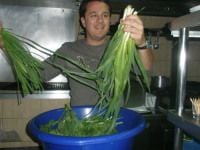
Ancient Grains and Modern Tastes Kritamon Restaurant, Archanes, Crete Tuesday, February 1, 2011 7:00 pm - 10:30 pm Presented by Chef-Proprietor Dimitris Mavrakis, Kritamon Restaurant Organic Vintner Evangelos Sinadinakis, Eltina Wines in collaboration with Nikki Rose of Crete’s Culinary Sanctuaries A four-course dinner featuring fresh, local organic ingredients paired with organic wines. Full menu link 26 Euros per person Advance reservations required. Space is limited to 30 people. Contact Kritamon directly to make reservations Tel 2810 753092
After 20 years in business, it seemed time to try another format for our popular EcoTourism Management newsletter. It isn't exactly NBC News but I thought a video version might be more engaging; it seems people are reading less and watching more. While you won't have time to get through a whole bowl of popcorn (maybe a handful) while you watch this, I'm hoping it still conveys some food for thought. http://www.14dd5266c70789bdc806364df4586335-gdprlock/user/Reinventure?feature=mhum#p/a/u/0/WwUiyLQsKNU You can still read the written version at http://www.kalahari-online.com/winter11.pdf Let me know which version you prefer! Happy 2011 Carol
Chitral Association for Mountain Area Tourism (CAMAT) facilitated the participation of artisans from the Chitral district to Lok Virsa Handicraft/ Looming Exhibition in Shakarparian, Islamabad from December 28 to30, 2010. The purpose of the exhibition was to highlight the products from different parts of Pakistan, giving market linkages and exposure opportunities to artisans to learn from each other’s work. Chitral’s pavilion attracted a good number of visitors who showed interest in the handicrafts and bought Chitrali cap, woolen and goat-hair carpet, wooden spoon and so on. In the meantime, training about looming was also imparted to artisans aimed at diversifying their products and to make it more market-friendly. This could be possible by changing the designs, patterns and color system of the products. Likewise, the frame looming which is in vogue in Chitral has to be changed for an easier method called ‘pit looming’, practiced in Sindh and Punjab. It is quite worrying that at present the handicraft of Chitral is at cross-road. The work, which is more or less women-centered, is labor-intensive whilst the price is not as encouraging as to engage young generation. This means the handicraft is dying out. The only safe way to protect it is by...