As I wrote in one of my recent travel stories, people are keen to see bears. Now there's an app for that. Where's the Bear app tells you where bears have been spotted in Yellowstone. Bears are popular sightings with tourists It makes it easier for wildlife watchers to see bears but it can also lead to bear jams and cause habituation of bears to people. This can ultimately lead to bear deaths. I also wonder if such an app could help poachers find wildlife. Currently it is used in a protected area but Parks are facing budget challengs which means there isn't a ranger behind every tree. And what is to stop technology to be used in this way outside of protected areas? Sometimes technology has effects we hadn't counted on. What's your feelings on Where's the Bear app? You can post here or join a discussion on Flickr http://bit.ly/JWuqLz
ECOCLUB Blogs™
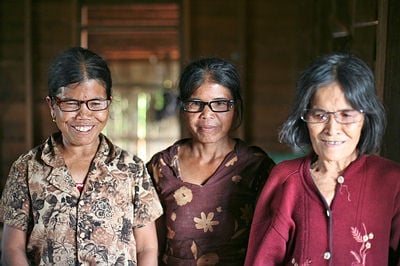
The Traditional Arts and Ethnology Centre in Ban Khamyong, Luang Prabang province, Laos (TAEC) is a non-government museum that relies on ticket and shop sales to keep its doors open. Grants and donations allow us to undertake significant research, conservation and education projects. Here in Laos, public cultural institutions and academia are in their infancy. The Traditional Arts and Ethnology Centre was founded to promote understanding of Laos’ ethnic diversity and advocate for the survival and transmission of its cultural traditions. Now is a critical time, as Laos undergoes rapid modernisation and economic development. TAEC believes in supporting not just cultural traditions, but sustainable livelihoods for rural ethnic minorities. When TAEC visits communities for research, we not only ask questions about culture, but about village income levels, development issues, and education. TAEC maintains a small village fund to provide learning materials, health supplies, and emergency financial support to vulnerable source communities and community members. While in Luang Namtha, Salavan, Attapeu, and Champassak provinces for handicrafts work in early 2012, TAEC distributed eyeglasses (important for older women who have spent years on detailed embroidery or weaving work!) and children’s books from Big Brother Mouse. With US$50, we can provide a community...
Tales from the Frontier, "Out of the Chaos" By Costas Christ, from the May 2012 issue Story on Greek Tourism http://travel.nationalgeographic.com/travel/traveler-magazine/tales-from-the-frontier/greece/
Despite of the dificult country situation two small hotels from Honduras decided to become certified in order to show their engagement not only with the sustainable field but also with the social responsibility towards their local communities. These hotels have been certified in August 2011 by ICADE, with Smart Voyager seal, and have just been recognized by the Sustainabletrip.org website. This international website awards and promotes Latin America’s hotels that perform actions for the conservation of natural resources, is managed by the Rainforest Alliance and BID FOMIN. If you want to know more about these hotels and in order to book, click on the link below : http://www.sustainabletrip.org/search/index.cfm?cid=28&tod = The group Casa del Arbol Hotels in San Pedro Sula and the Hotel Guancascos in Gracias, Lempira, became the first hotels in Honduras to obtain an International Certificate in Sustainable Tourism. To qualify for this seal both hotels have been through an arduous process of implementation of various best practices in their operations, and were audited by a team of professionals from ICADE, Honduras and the Conservation and Development Corporation of Ecuador, using the Smart Voyager Standard, the result of this process scored a value higher than 90% compliance for them.
San Francisco, California, April 5, 2012, 5:30 pm – 7:30 pm. Presentation on cultural-culinary heritage preservation projects in Crete, Greece by Chef Nikki Rose, Founder of the award-winning Crete’s Culinary Sanctuaries Eco-Agritourism Network. Rose is author of “Crete: The Roots of the Mediterranean Diet, enjoying the benefits of one of the world‘s healthiest cuisines wherever you live.“ Presentation followed by book signing and meze at Roots Restaurant, Orchard Garden Hotel, 466 Bush Street, San Francisco, CA. Space is limited. Advance reservations required. Details: http://www.cookingincrete.com/Nikki-Rose-Book-Presentation-Crete-The-Roots-of-the-Mediterranean-Diet3.html
While the E.U. is pressing airlines to cut carbon emissions, and the US and China traditionally trying to block any global climate action measure, an online debate on the burning (literally) and usually swept-under-the-carpet issue of "whether 'sustainable' tourism can include flying" is being held at the University of Central Lancashire, UK on 30th March. Valere Tjolle and Dr Davina Stanford will defend the sustainability of flying while Professor Les Lumsdon and Paul Peeters will oppose it. Details can be found at http://www.uclan.ac.uk/schools/ssto/research/itt/debate_can_sustainable_tourism_include_flying.php and http://www.2343ec78a04c6ea9d80806345d31fd78-gdprlock/FlyingDebateUCLan For anyone who approaches and understands ecotourism as ecological tourism and not just as elitist nature travel, it is clear that flying is problematic to say the least. I prefer bikes, trains, hiking, public transport, social tourism, accessible for all. Jetting off to a luxury award-winning pseudo-eco resort at the other end of the planet has little to do with ecological principles. But "sustainability" is a different ball game, it is an apolitical term, excellent for use in consultants reports, just like corporate social responsibility. Perhaps a debate on the "corporate social responsibility' of airlines should follow :) Now, for a truly eco way of flying, Icarus-style, watch the video below, although it's a hoax:
A note on the question of biological control following the publication of an opinion piece by Professor David Bowman of our School of Plant Science in Nature, vol 482, p.30, 2 Feb 2012 titled: “Conservation: Bring elephants to Australia?" David’s comments were grounded in concerns about the inability to control one of Australia’s worst environmental weeds, African gamba grass, which could transform north Australian landscapes such as World heritage listed Kakadu wetlands, into landscapes of greatly reduced biodiversity. Native Australian animals (kangaroos, euros, wallabies, etc) cattle, and other introduced feral animals (camels, horses, pigs) are unable to control the spread of this exotic plant, finding it unpalatable. As gamba grass takes over, populations and diversity of native animals and birds are significantly reduced. And as its biomass increases the risk of devastating bushfires, with consequential increased ‘collateral’ damage to native wildlife, also intensifies. Fire apparently increases its spread through vigorous re-growth instead of destroying it. David’s left-of-field idea was that since gamba grass is standard fare for elephants and rhinos one element of land management might be accomplished by bringing them into affected areas (and incidentally: i) diversifying conservation efforts for these endangered species because of Australia’s ability to control poaching; and ii)...
Normal 0 21 false false false MicrosoftInternetExplorer4 /* Style Definitions */ table.MsoNormalTable{mso-style-name:"Table Normal";mso-tstyle-rowband-size:0;mso-tstyle-colband-size:0;mso-style-noshow:yes;mso-style-parent:"";mso-padding-alt:0cm 5.4pt 0cm 5.4pt;mso-para-margin:0cm;mso-para-margin-bottom:.0001pt;mso-pagination:widow-orphan;font-size:10.0pt;font-family:"Times New Roman";mso-ansi-language:#0400;mso-fareast-language:#0400;mso-bidi-language:#0400;} v:* {behavior:url(#default#VML);}o:* {behavior:url(#default#VML);}w:* {behavior:url(#default#VML);}.shape {behavior:url(#default#VML);} Normal 0 21 false false false MicrosoftInternetExplorer4 st1:*{behavior:url(#ieooui) } /* Style Definitions */ table.MsoNormalTable{mso-style-name:"Table Normal";mso-tstyle-rowband-size:0;mso-tstyle-colband-size:0;mso-style-noshow:yes;mso-style-parent:"";mso-padding-alt:0cm 5.4pt 0cm 5.4pt;mso-para-margin:0cm;mso-para-margin-bottom:.0001pt;mso-pagination:widow-orphan;font-size:10.0pt;font-family:"Times New Roman";mso-ansi-language:#0400;mso-fareast-language:#0400;mso-bidi-language:#0400;} MamboViewPoint is owned by social entrepreneurs Marion Neidt and Herman Erdtsieck. They travelled through many continents, cooperated with various development agencies and saw very many development projects. In the end they felt unhappy with the often very poor or even counterproductive results of many aid projects and all the money that went to expensive overhead, offices and 4x4 cars. All previous experiences resulted in a plan for a new approach. The basic idea was to create a permanent socio-economic stable base in a poor area and to start regional development from there. In our vision development is not based on unconditional aid but should be achieved by empowering people, building capacities, giving them ideas and information, knowledge, expertise and support them in obtaining tools. As our current experience learns it sometimes only needs a little push to enable people to pull themselves out of poverty. There are some important features in our concept. First, development is not a...
Like in all places around the world, in Mambo and the surrounding villages there are many children who want to study after their primary school. However there is a difference... Some are not able to go to the secondary school because their parents can't afford to pay it. Some bright kids can't study on the university because they can't afford it. MamboViewPoint tries to connect young and bright students with sponsors from abroad. The Kids are selected on forehand. MamboViewPoint controls if the money really is spent for the study and if the results are good. School fees will be paid direct to the schools MamboViewPoint will take care for a regular report. MamboViewPoint reports the progress to the donors. Sponsoring possible on individual base with knowledge of all parties or anonymous. Donors can have direct contact with the pupils and even visit them. In case of problems MamboViewPoint will assist to clear them. Read more about the Tanzania education system, statistics and the technical details 1. Scholarships for primary school kids: $40/yr for 6 years. The primary school is free of charge and compulsory. Still we know some kids that are not going to school. A main reason is...
Greetings from Crete's Culinary Sanctuaries Eco-Agritourism Network. We are celebrating our 15th year of organizing award-winning sustainable tourism and study abroad programs in Greece. Check out our 2012 open programs: http://www.cookingincrete.com/Schedule.html