The UNWTO this year has picked "Tourism and Water" as the theme of the World Tourism Day. Should they/we be celebrating? While access to clean water and sanitation is not a given for over a billion people in the global south, northern multinationals, use vast amounts of water (private swimming pools, golf courses) often in semi-arid and arid areas, to pamper their affluent guests in luxury resorts / enclaves for the rich that displace vulnerable communities and destroy coastal ecosystems. General annual "parental-advisory" type calls on holiday-makers to voluntarily "minimize" or, worse, "offset" their water use are hypocritical and simply do not work. Can private water offset projects, even technologically-novel ones such as those producing water from air humidity, replace a government's responsibility to provide water and sanitation to all inhabitants in a general, permanent and not sporadic manner (i.e. one village has water due to the benevolence of private benefactors, 10 villages nearby do not). Does anyone seriously believe that meeting basic human needs can be left to "Corporate social responsibility" and voluntary corporate participation in paper schemes, most of which can certify & guarantee little more than the rate of bathroom towel change? That said an unequal, neocolonial tourism model...
ECOCLUB Blogs™
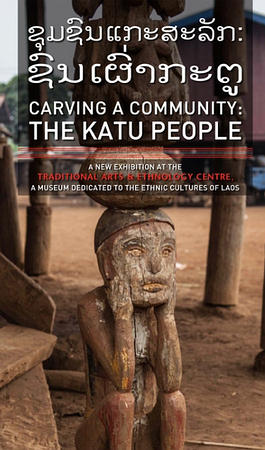
A new special exhibition is opening on September 20, 2013 at the Traditional Arts and Ethnology Centre (TAEC) in Laos. "Carving a Community" is the first exhibition in Luang Prabang to highlight an ethnic minority group from the south of Laos. Highlights of the exhibit include intricate weavings and basketry and the bold carvings adorning Katu communal meetinghouses. Carving a Community: The Katu People highlights the distinct cultural traits and crafts of the Katu residing in southern Laos and the central highlands of Vietnam. Intricate weavings and basketry and bold woodcarving created by the Katu people are highlights of the exhibit. Of special interest is the carved decoration of the Katu communal meetinghouse. Traditionally, the meetinghouse was the focal point of the village, where members of the community gather to carry out important rites, including buffalo sacrifice. Videos of this annual ritual and daily activities will allow visitors to witness the folkways of the Katu. This exhibit opens on 20 September 2013 and will be up for one year. TAEC is home to a rotating display of informative and engaging exhibitions, offering a rare and fascinating insight into the diversity and richness of Laos' ethnic cultures. Our exhibits feature objects from...
I will be attending the upcoming 2nd European Ecotourism Conference (http://european-ecotourism.eu) in Romania, from October 23-25. Some of the European-based ECOCLUB members have attended the 1st EuroEco conference, which was held in 2010 in Estonia. I was also part of the 2010 conference, and particularly enjoyed the interactive and collaborative sessions (we had many "World Cafe" group discussions, which I found very engaging and productive). This year's program also features "World Cafe" sessions, as well as presentations by ecotourism practitioners from across the region (see full program: http://european-ecotourism.eu/pages/program). If you are based in Europe (and even if you're not, as long as you're interested in ecotourism in Europe), this will be a great place for learning and networking, as well as experiencing ecotourism in action in some of the unique rural destinations in Romania. >> If you plan of attending and have already registered, also check out the Facebook event page: https://www.2343ec78a04c6ea9d80806345d31fd78-gdprlock/events/361046020675185/ >> If you're interested in joining, you can find registration and other information on the conference website: http://european-ecotourism.eu (see the "Delegate Information" section) Disclaimer: Although I no longer work with The International Ecotourism Society (which is one of the partners for the conference), I was involved in the...
Have you felt cheated by a product that changed its name only for the purpose of “appearing green”? Or when you tried to book an environmentally friendly hotel the information wasn’t clear and you didn’t trust them? Well, companies have gone too far with greenwashing their brands by using “green campaigns” only to trick customers into believing fake sustainability practices that now customers have lost trust and are tired. But as a business owner who really cares about the environment, how can I effectively use it and gain customers’ trust back? respondeco.travel believes that by following our recommendations you will improve your sustainability communication and attract new and former customers. Since customers care about sustainability, showing it on your website not only adds value but also makes you look good while they decide to book a room. Be smart: tell them about your sustainability actions and how they benefit from them; be social: post reviews about customer’s green actions during their stay and how great they felt about it; be reliable: share what new improvements you have made since customers left and how is good for them, you and the environment. Visit us!http://www.responsibletourismcommunication.com/
Have you felt cheated by a product that changed its name only for the purpose of “appearing green”? Or when you tried to book an environmentally friendly hotel the information wasn’t clear and you didn’t trust them? Well, companies have gone too far with greenwashing their brands by using “green campaigns” only to trick customers into believing fake sustainability practices that now customers have lost trust and are tired. But as a business owner who really cares about the environment, how can I effectively use it and gain customers’ trust back? respondeco.travel believes that by following our recommendations you would improve your sustainability communication and attract new and former customers. Since customers care about sustainability, showing it on your website not only adds value but also makes you look good while they decide to book a room. Be smart: tell them about your sustainability actions and how they benefit from them; be social: post reviews about customer’s green actions during their stay and how great they felt about it; be reliable: share what new improvements you have made since customers left and how is good for them, you and the environment. Visit us! http://www.responsibletourismcommunication.com/
Workshop in Crete, Greece May 12 - 20, 2014 Lessons from the Mediterranean: Applying Yesterday's Wisdom to Tomorrow's Table Continuing Education for Food, Nutrition & Health Professionals. A 7-day workshop-experiential learning program. Organized by Crete's Culinary Sanctuaries Eco-Agritourism Network and Field to Plate. CPEs: RD/DTR: 49; American Culinary Federation CEHs: 35 http://www.fieldtoplate.com/2014-crete.php
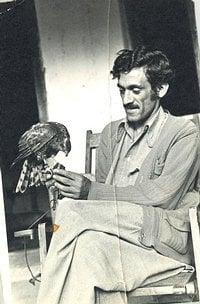
Sardar Ahmed Khan, the polo legend of Northern Pakistan, though discreetly restrained his polo pony, yet inauspiciously failed to rein in the disloyal horse—‘sorkhon istor’—Syar’s metaphor for ‘death’ versified in one of his poems. He passed away on January 27, 2013 of cardiac arrest aged 59. May Almighty God rest his soul in eternal peace! Amen! His death left his family, relatives, friends and fans greatly sad and created an irreparable void in the field of polo. He will be sorely missed for long time to come. Born to the distinguished Mohd Baig tribe, SA Khan inherited refined manners, passion for indigenous culture and taste for traditional sports i.e. free style polo and falconry, which he assiduously promoted in his life time. His grandfather, being close to Chitral's ruling family, owned extensive landed property, which reinforced by prolong socio-cultural influence, grossly determined the family’s role as a key decision-maker in the local affairs. Free style polo minus SA Khan would be inconceivable. Through incredible skill reinforced by his indomitable spirit, he credited Chitral polo team with a range of victories in mega events like Shandur Polo and District Polo Tournament. “He was an avid and efficient game deviser who staged effective...
AlJazeera on June 11 did a special feature on "Slum" Tourism see http://stream.aljazeera.com/story/201306102246-0022819 If such tours are organised by the community itself (or genuine members thereof), following some sort of democratic decision / consensus process, and all proceeds are used to meet the real needs of the community then such tours are acceptable, and will tend to be respectful, meaningful and life-changing for participants. It then becomes a form of solidarity tourism and depending on how it is being promoted (content & channels) it may also attract suitable, politicised tourists not just the curious. "Slum Tourism" is however not a real solution to the problem of Slums, as Slums are the direct and visible products of capitalism, inequality and racism, the causes need treatment, not the symptom. It is of course easy (and safe) for large international media to criticise those small operators who are trying to do the right thing the wrong way in difficult areas and circumstances, compared to - say - exposing powerful multinational tourism companies or the exploitation involved in luxury tourism - as they are usually their best advertisers.
Dear All, Shandur Polo Festival 2013 is set to be celebrated from July 2-5, 2013. In consideration of the month of fasting, the event has been scheduled about 5 days earlier than usual. The event attracts great number of international, national and local tourits, who undergo long travel to participate in the event. You can be in contact with us should you or your friends plan to participate in the event. Our contact is +92 3025975059
On this years World Environment Day it is becoming clearer, through a wide range of developments ranging from the violently suppressed ecological protests in Istanbul, the popular anti-gold / anti-multinational mining campaign in the forest of Skouries, near Halkidiki Greece, the ongoing struggle of indigenous communities against oil giants in the Amazon and against bauxite in India, the growing anti-fracking movement in the United States, widening global awareness about Climate Change and its main causes (Capitalism in all its forms: authoritarian, statist or neoliberal) and a constant flow of tragic sweat-shop deaths that reveal the ugly backstage of consumerism that the Environmental Movement can no longer remain or pretend to be apolitical, and that it must pick sides – either the 99% and the side of progress, of the people, or the 1%, the side of the ecocidal status quo. Or, as Noam Chomsky put it in a recent editorial, “... those who are trying hard to do something about these threats [to destroy the planet], and others who are acting to escalate them.” The process of choosing sides is of course slowly undermining the credibility of large systemic green NGOs who may in turn have to chose between their corporate...