
"In my view, the ‘emotional’, ‘romantic’, ‘idealistic’ aspects are crucial. However, if they are not combined with pragmatic economic/commercial viability, they remain just that. If they are married to economic viability, the project can become so powerful that it is almost unstoppable."
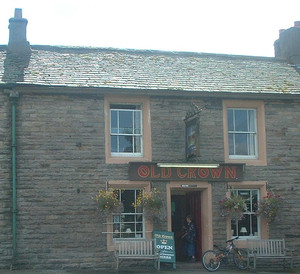
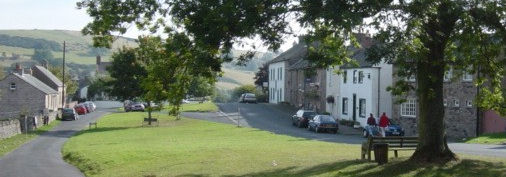
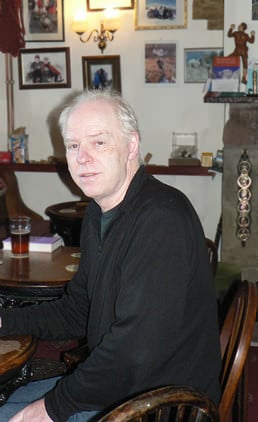 Julian Ross is chairman of The Old Crown co-operative in Hesket Newmarket, believed to be Britain’s first co-operatively owned pub. In his ‘day job’ he works from home as a full-time freelance translator. He has lived in Cumbria for 11 years with his wife Tori, who first introduced him to the delights of The Old Crown. The Old Crown is a public house in the small village of Hesket Newmarket, situated just inside the northern edge of the Lake District National Park, nestling in the Caldbeck fells. It is the only public house in the village. When The Old Crown came on the market in 2002, a co-operative was formed under the leadership of Julian Ross in order to prevent the pub from either closing or being sold to parties who might change its character. 125 customers of the pub eventually clubbed together to buy the pub, each chipping in £1500 to fund the purchase. The Co-operative was officially registered as a community industrial and provident society in March 2003, and the purchase was completed on 21 August 2003. The Old Crown is believed to be Britain’s first co-operatively owned pub. The pub is now a thriving, happy, lively place which is fulfilling its role as the heart of the village community, a place where regulars and visitors alike will find a warm welcome, good, simple food, a friendly smile and a superb range of real ales.
.jpg)
ECOCLUB.com: Were the reasons behind the creation of Britain's first co-operatively owned pub mainly ideological, romantic or practical-economic?
Julian Ross: Fairly marginal. We did receive some grant funding, for which we were very grateful, but the vast bulk of the funding was raised from the share issue.

ECOCLUB.com: Are every-day and longer-term business decisions taken in a different way than in the average pub? And do all shareholders get an equal say, or does it depend on the number of shares they own? In terms of day-to-day management, is there a management hierarchy and a permanent allocation of roles (a paid staff) or do shareholders participate or rotate even?
Julian Ross: We do not run the pub ourselves, but lease it to tenants who run the business. They pay us rent. This means they have the incentive to grow the business (because they keep the profits), but also carry the business risk. They also employ bar staff, restaurant staff, etc.The actual day-to-day running of the pub is the responsibility of the tenants. We as the co-operative (owners of the pub) are effectively a property company, who lease out the premises to tenants to run the pub for us, in accordance with the terms of the Lease, which is quite specific about what they can and cannot do. Any major decisions that have to be made by the co-operative, as the owners of the building, are discussed in a meeting with shareholders. We proceed on the basis of consensus and collective commitment.There are 148 shareholders. No one owns more (or less) than one share. Also, no one has more than one vote. Everyone has an equal say.
Julian Ross: There is a micro-brewery behind the pub, which is owned by a separate co-operative (though of course the two are closely linked). As the pub co-operative, we are single-object company and have no desire to take over the world! However, the success of The Old Crown does have a spin-off effect in the local community, boosting trade at local B&Bs, holiday cottages, village shop, etc. etc.
Julian Ross: Not directly, though The Old Crown has received publicity in several other countries.
Julian Ross: Any time is a good time!